
Welcome to this edition of our Tools for Thought series, where we interview founders on a mission to help us think, connect, and live better. This week, we talked to Carly Valancy, founder of TETHER and Reach Out Party.
In this interview, we talked about meaningful connections as a competitive advantage, how to experiment with connecting with others, how to treat your network like a garden, and much more. Enjoy the read!
Hi Carly, thank you for joining us. You’re passionate about helping people make meaningful connections. Why do you think this is so important?
When I started my career, I reached out to one person every day for 100 days and it changed my life. I realized that we have so much more agency over who we know than we think, or want to think. I learned that you don’t have to be in the right place at the right time to make meaningful connections. Your network isn’t some fixed inheritance. It’s alive, like a garden is alive. When you feed it and tend to it, it will grow in ways you couldn’t have imagined. When you neglect it, it will wilt.
Our lives literally are made up of the relationships in them. Life really is about who you know. When you break down what is such a common cliche, you find a deep truth underneath it.
I believe meaningful connections are the ultimate competitive advantage in a world increasingly mediated by screens and algorithms and AI. Our ability to build genuine human relationships has always been important, but it’s able to become even more valuable.
How did you come up with the idea for TETHER?
I moved to NYC to pursue a career as an actor, at the bottom of a very hierarchical industry. As an attempt to break out of this system, I conducted an experiment to reach out to one new person every day for 100 days. The experiment changed my life. In those 4 months, I found opportunities that would have taken me years to find and I tracked it all in a chaotic Google spreadsheet that became a tangled mess of names and context.
Tracking gave me incredibly interesting data. I knew what my response and rejection rate was. I could see what was working and what wasn’t. Aside from actually making connections, tracking those connections led me through pivots from theatre into tech into starting my own business. But the more I used it, the more I could feel connections slipping through my fingers. Following up was impossible, and every time I opened it, I felt overstimulated.
I tried using traditional CRM tools, but they felt gross… So I just stopped keeping track. For years. And once I stopped keeping track, I stopped reaching out. And slowly, all of these beautiful seeds I’d planted started wilting.
TETHER was born from this tension: I needed a system that was intentional. That helped me stay organized but allowed me to stay creative. And that motivated me to keep showing up. Something that honored the messiness and magic of real human connection while still giving me structure.
What started as a simple Notion template for myself, turned into a whole operating system that I started sharing with others. It is a system that will help you pay attention to making connections.
A tether is the gentle support system that guides a plant’s growth, prevents it from falling over or growing uncontrollably. That’s what I’ve always wanted for my network. Something that steers growth in a specific direction while leaving room for serendipity.
You built TETHER for “extroverted introverts” – what does that mean?
Okay, so I genuinely love people. I love the energy of a good conversation, the serendipity of meeting someone new, the way a single email can change the trajectory of your life. That’s the extrovert part.
But I also find traditional networking exhausting and overstimulating and performative. Making many surface level connections feels transactional and makes me want to hide. That’s the introvert part.
Extroverted introverts are people who want depth in their relationships. They want to connect but often feel overwhelmed or icky about how they’re “supposed” to do it. They know relationships matter, but the whole networking industrial complex feels soul-sucking.
The ideal TETHER user is someone who knows they should be reaching out more but keeps putting it off because it feels like a chore.
What I’ve learned is that a lot of very ambitious, very creative people avoid networking not because they’re antisocial, but because the systems we’ve been given are not made for us.
What’s the difference between Tether and existing CRM tools?
Most CRMs are built on this philosophy: reach as many people as quickly as possible, track them through stages, automate sequences, optimize for some kind of outcome or conversion.
TETHER is the opposite. It’s built for human beings prioritizing clarity, intention, and generosity over spammy outreach. It’s like a beautiful container for serendipity to grow.
When you open TETHER, you see your goals, your connections, and prompts to be thoughtful about who you want to reach out to and why. It is designed for individuals who want to grow their network intentionally, whether that’s freelancers, founders, writers, artists, or anyone navigating a career transition.
Being a Notion OS, the automations are simple. The point isn’t to remove friction from reaching out, it’s to make the friction meaningful. When you sit down to send a message through TETHER, you’re making a conscious choice to prioritize connection as a practice.
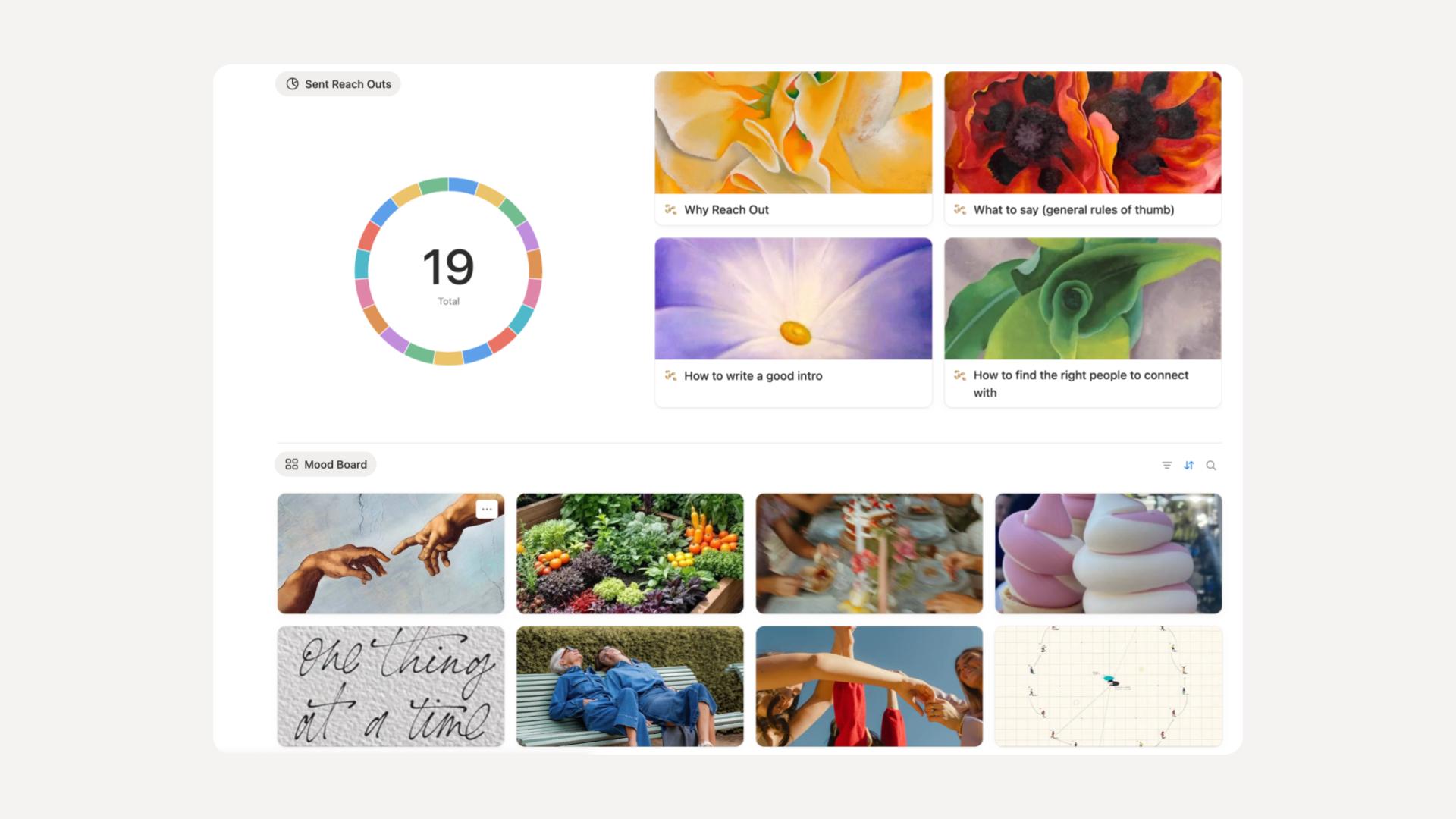
It includes a resource center, challenges, a gorgeous way to view your data, and goal-setting frameworks. And of course, it is full of Georgia O’Keeffe artwork, ensuring that your nervous system is instantly soothed every time you open it.
Let’s talk about how TETHER works in more detail.
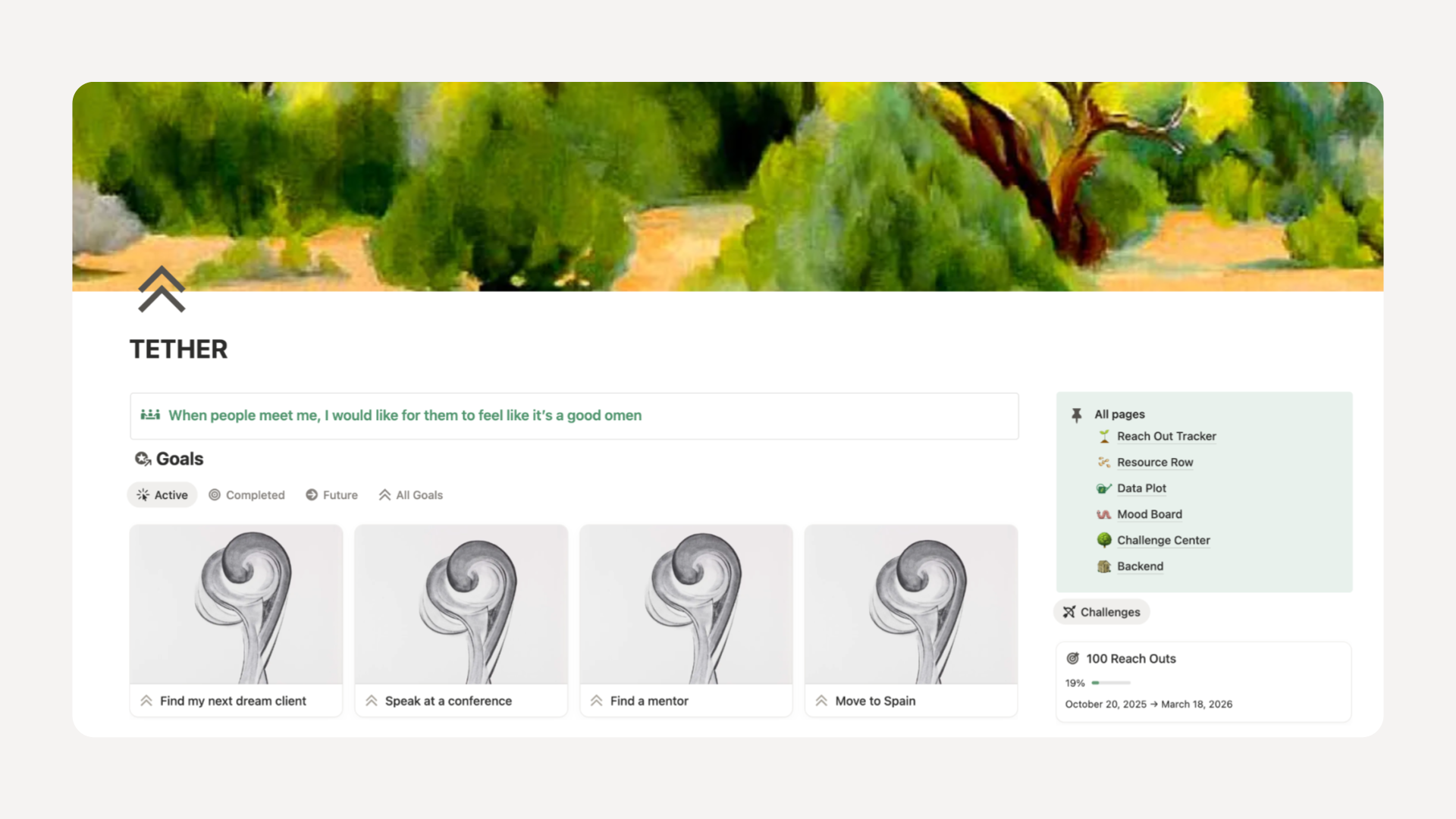
When you first open TETHER, you start with your goals, intentions, and values. I recommend three goals, two professional and one personal. These will help you find clarity on who you should be reaching out to. These goals serve as a constant reminder for what you want your network to help you achieve.
The main dashboard shows you your “Reach Out Tracker” which is where the magic happens. Instead of a traditional CRM’s intimidating spreadsheet of contacts, you see a curated view of people organized by how they relate to what you’re trying to accomplish.
The Reach Out Tracker is where you log who you’ve reached out to, when, and whether they responded. Over time, it becomes this beautiful record of all the seeds you’ve planted.
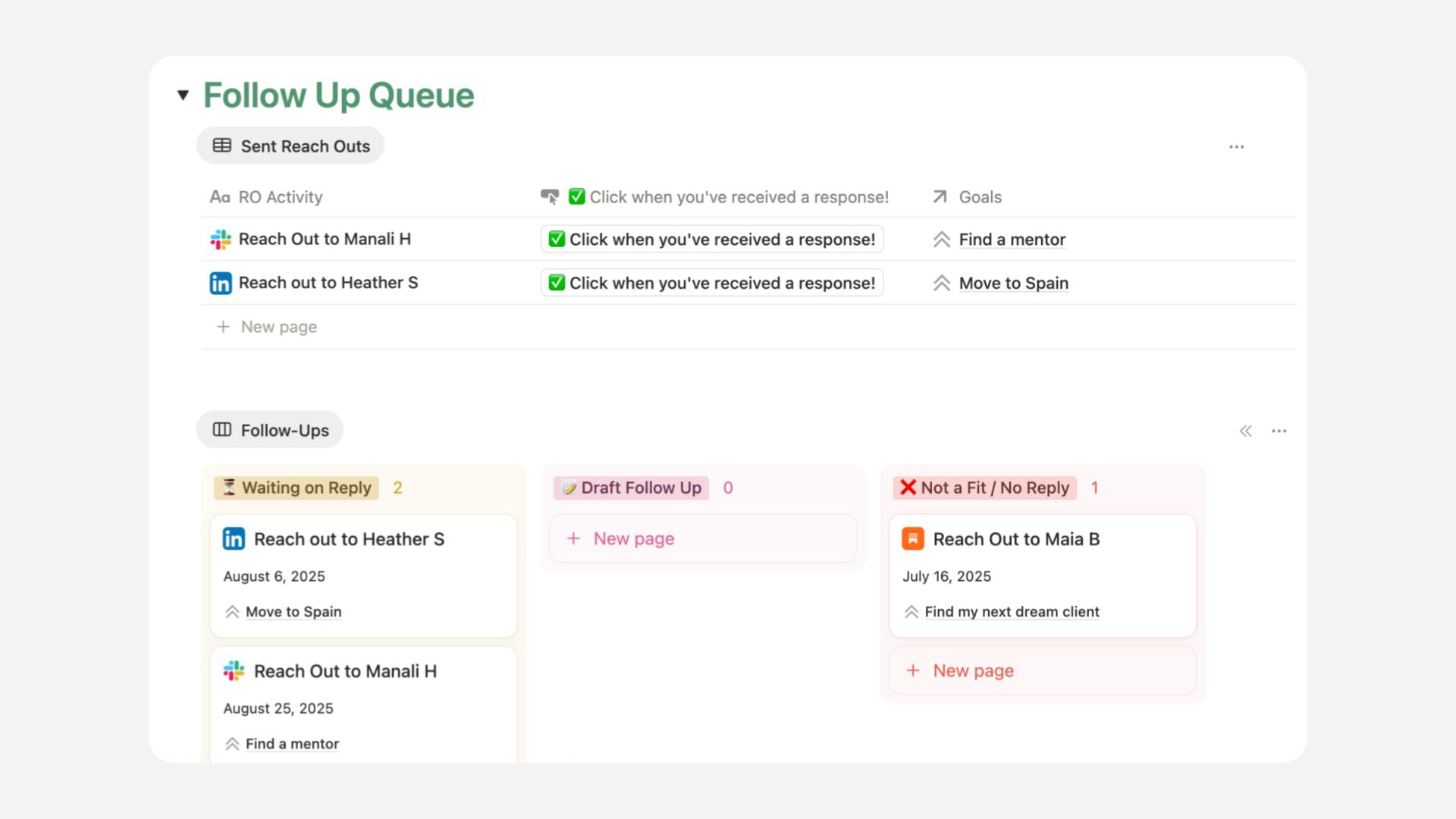
Once you receive a response, they move into the Nurture Queue, where you can decide whether there is any action needed or whether you just want to move them into a Keep In Touch folder for the future. If you don’t receive a response for over one month, connections will be filtered into a Follow Up Queue so no one unintentionally slips through the cracks.
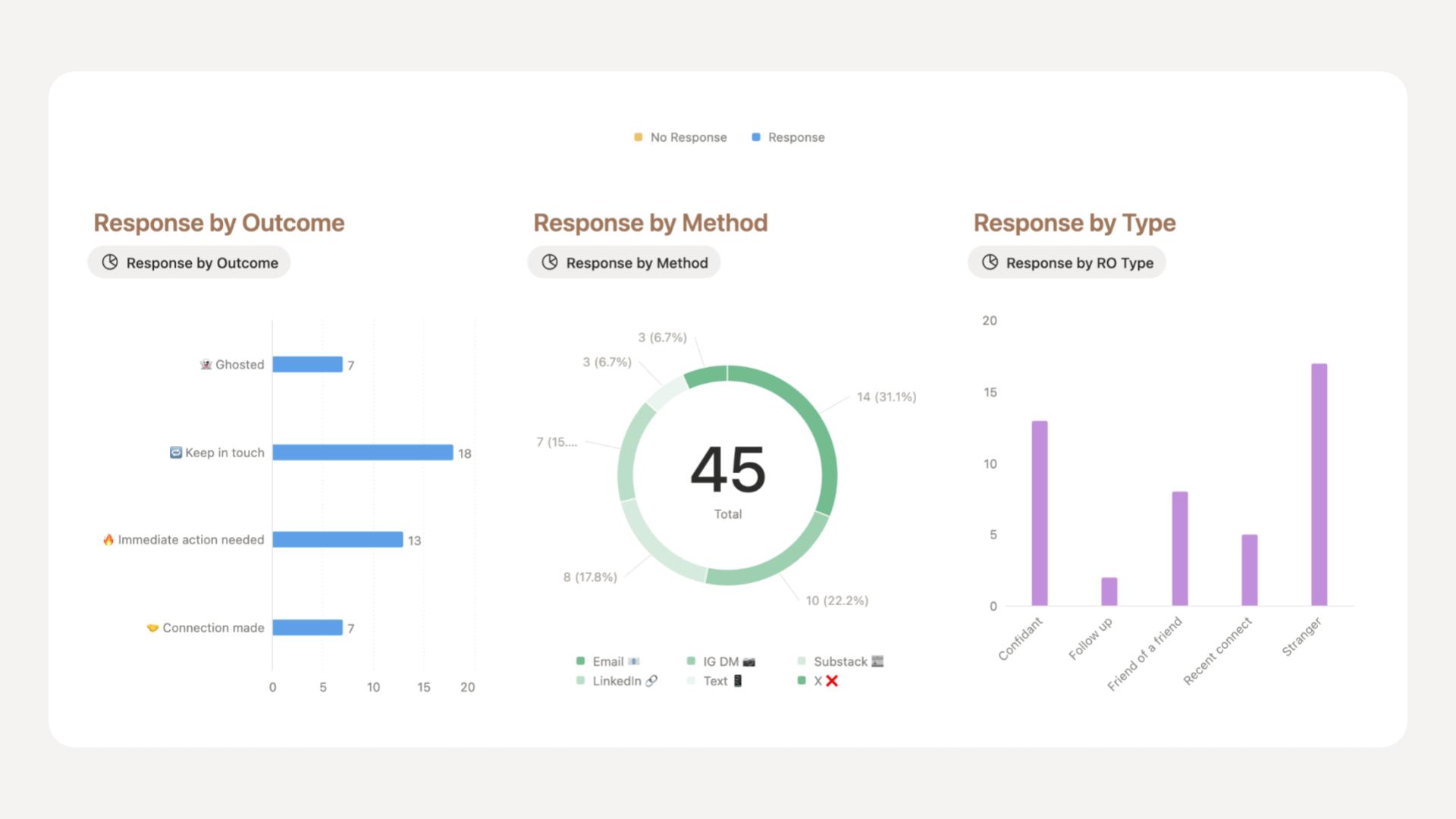
There’s a Data Plot feature that visualizes your progress and shows you your results in real time. You can track response rates, rejection rates, and most importantly, just see that you’re doing the thing consistently. That visibility is motivating.
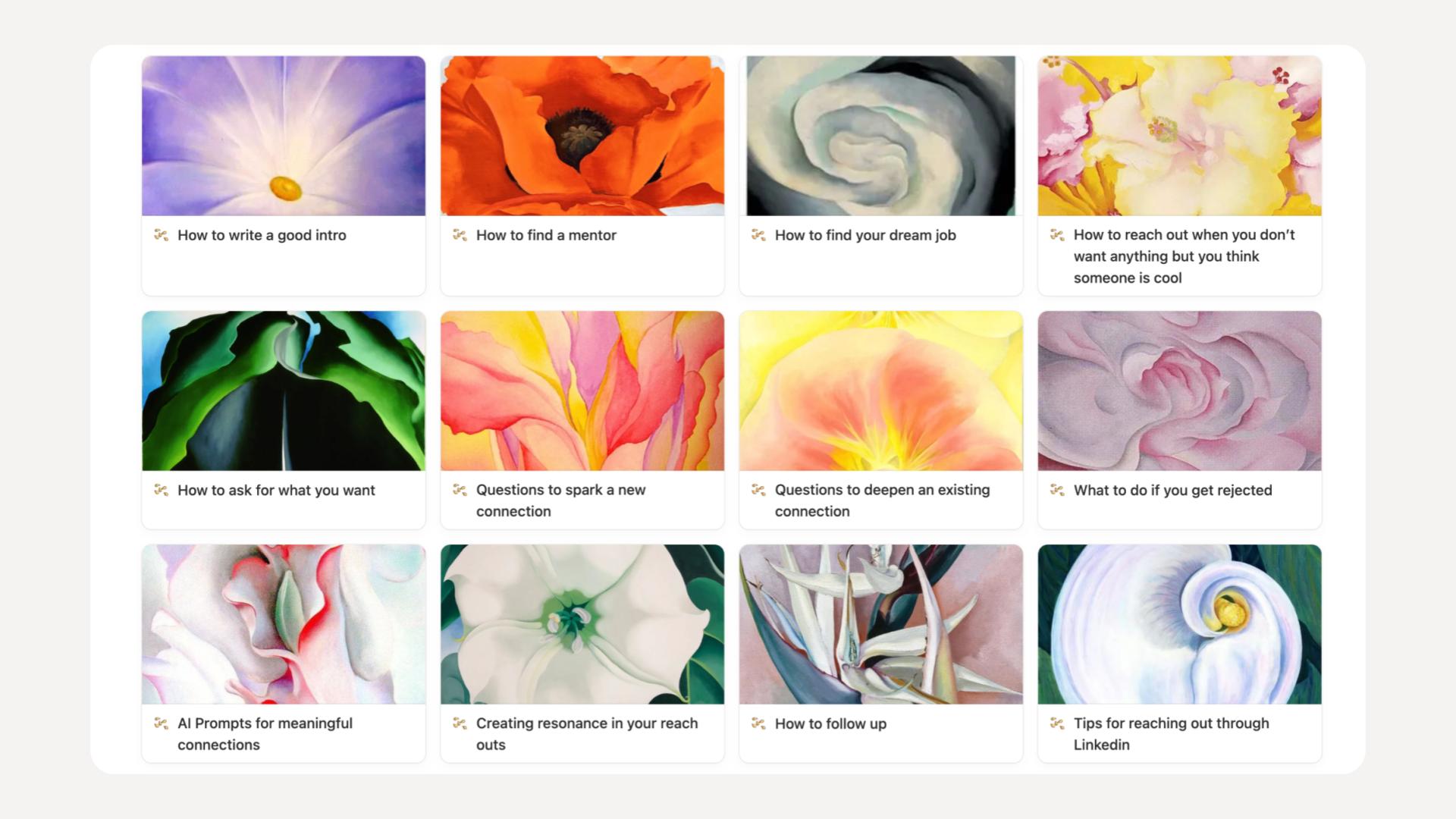
The Resource Row is a growing collection of tips, examples, and templates. Real examples of messages that worked (and some that didn’t), frameworks for different scenarios, prompts for when you’re stuck. It’s designed to make digital networking feel soft and warm instead of cold and scary.
There’s also a Mood Board for collecting good vibes and a Challenge Center for those of you who like tiny experiments.
Who is using TETHER today and what are some of the main ways they’re using it?
Creative people. Artists, writers, freelancers, consultants, founders, investors, portfolio-careerists. TETHER’s functionality adapts for anyone in any industry, but works best for people that are ready to change their relationship to networking.
One pattern I love is that lots of people seem to be using TETHER to navigate big life changes, from career pivots to moving to a new city.
Some people do daily challenges like I did originally. Others commit to weekly. Some use it more for maintenance, checking in to make sure important relationships don’t slip through the cracks.
What about you, how do you personally use TETHER?
I’m currently in the middle of my second 100-day challenge. Reaching out to one person every working weekday.
My daily rhythm looks like this: I open TETHER and head to my tracker. Sometimes I have a few new people in the queue, sometimes I’m following up, sometimes I come across someone totally unexpected I want to reach out to.
Most days, the reach out itself takes about 20 minutes total. Even though I believe in the value of this practice so much, most days I still really don’t want to do it. It takes a lot of emotional energy to put yourself out there knowing you could be rejected.
I come back to TETHER once I’ve hit send and celebrate my progress before clicking out of it and continuing with my day!
What I love about using it myself is seeing my progress compound. It keeps me showing up. After 50+ days of consistent reaching out, my response rate, my confidence, and my sense of what works have all improved dramatically. I can see patterns I never would have noticed otherwise.
Looking ahead, how do you see TETHER evolving over the next few years?
I believe that treating connection as a practice can change your life, and I want to help as many people as possible experience that.
In the near term, I’m focused on building out the educational component. More templates, and frameworks for specific goals and situations. I’m also developing a more built out version for Reach Out Party, my mastermind that pairs TETHER’s system with accountability and coaching for reaching specific goals.
Longer term, I look forward to building software to support more ways to treat our network like the gorgeous garden it can be.
What I’m most excited about, honestly, is the cultural shift I’m starting to see. More people wanting genuine connection. TETHER is one tiny part of a larger movement toward building intentional relationships.
I really believe the future belongs to those who invest in soft skills. As AI makes automation the norm, our ability to build real human relationships becomes the ultimate edge. I want to be part of helping people develop that edge. Not through hacks, but through the slow, beautiful, compounding practice of reaching out.
Thank you so much for your time, Carly! Where can people learn more about Tether?
Thanks for having me! You can learn more about TETHER on the website, Substack, LinkedIn and Instagram. There’s also a dedicated page with more information about Reach Out Party. I’ve got about 4 spots left for the cohort that starts in March 2026. If you mention Ness Labs in your application, you’ll get $100 off.