
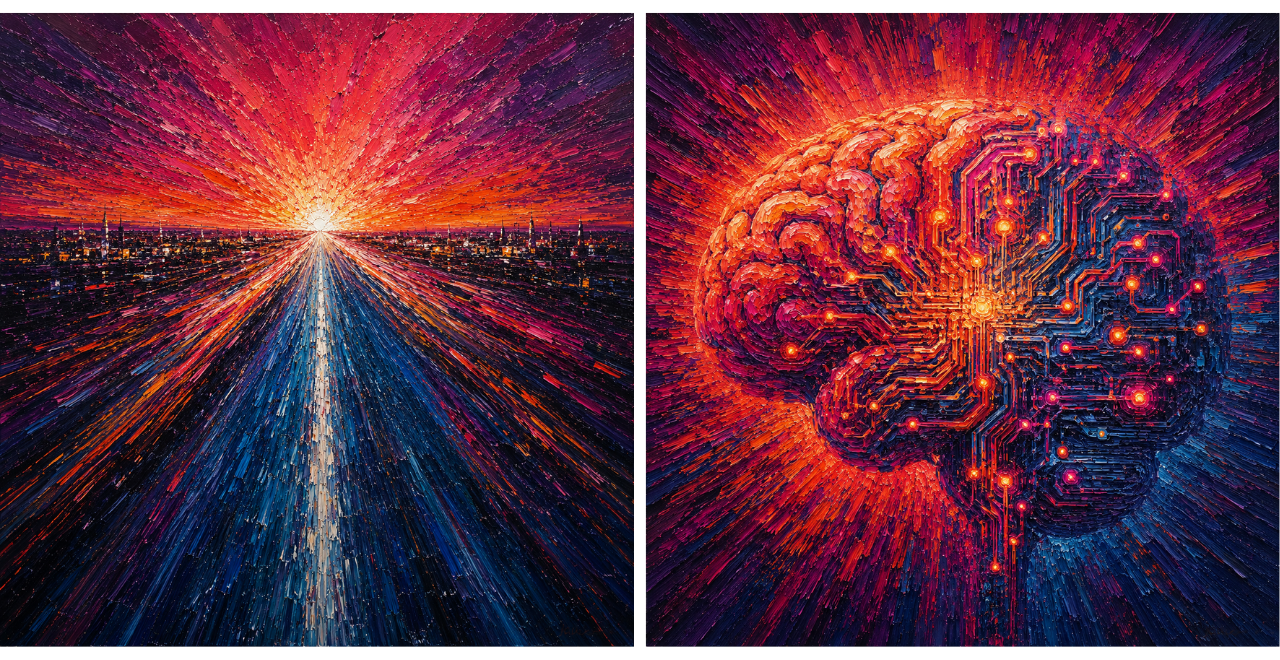
A colleague and I were recently comparing notes on how differently we work now versus a few years ago. He mentioned something that stuck with me: he remembers the content of papers he wrote before AI tools far better than recent ones.
I recognized the feeling immediately. There was a time when I knew I couldn’t read every study, so I had to be intentional about which threads to pull. I’d sit with a question for days between deep dives into the literature, turning it over, letting my curiosity grow before the next round of reading.
The journey was slow, sometimes frustrating, but it left a mark. I owned the answers I arrived at because I’d earned them through slow exploration.
Now I move faster and I cover more ground. But the path is harder to trace afterward, and the conclusions sometimes feel less like mine.
I think it’s easy to romanticize the older way of working and I don’t want to fall into that trap, but I do wonder what’s disappearing in the upgrade.
Yes, AI is exceptional at pattern recognition and synthesis. It can process vast amounts of information and surface connections that would take humans months to find. But AI exploration is computational and goal-directed. It works within known possibility spaces.
Human curiosity operates differently: it’s intuitive. For instance, Fleming wasn’t trying to invent antibiotics when he noticed mold killing bacteria in a contaminated dish. And Penzias and Wilson weren’t looking for evidence of the Big Bang when they discovered cosmic microwave background radiation. They were investigating unexplained noise in their radio telescope.
These breakthroughs came from noticing something unexpected and caring enough to follow it.
Human curiosity also carries something AI cannot replicate: context shaped by values and lived experience. We don’t just ask whether something works. We ask who it works for, at what cost, and whether it’s worth pursuing at all.
So the deeper risk isn’t that machines become more capable than us. It’s that when every gap in understanding gets filled instantly, we lose the conditions that make human curiosity possible: uncertainty, contradiction, and time to sit with what we don’t yet know.
So how do we stay curious when answers are available at our fingertips? Here are three practices I try to implement in my everyday work:
1. Delay the lookup. When you have a question, resist reaching for an AI answer straight away. Let yourself speculate, sit with the not-knowing. The idea isn’t to avoid AI entirely, but to give your own curiosity some space to unfold before AI fills in the blanks.
2. Use AI to expand your thinking, not replace it. Ask AI to challenge an assumption, surface angles you haven’t considered, or generate possibilities you can then evaluate yourself.
3. Protect unstructured curiosity time. If every idle moment gets filled with optimized content or instant answers, the slow, weird and wonderful questions never get a chance to emerge. Curiosity thrives in moments of boredom, on walks and in the shower, so make sure to not fill those spaces with podcasts and other content.
When answers are so abundant, the scarce resource is the quality of your questions – and the willingness to explore them for long enough.
So before you reach for the next answer, try staying with the question a little longer. This is how we’ll ensure curiosity doesn’t become a relic of a less efficient era.
Tiny Experiment of the Week
Ready to put these ideas into practice? Try this week’s tiny experiment:
I will [explore one idea deeply] for [5 days].
This experiment will help you spend more time following a single thread of curiosity instead of quickly jumping between instant AI-generated answers.
➤ Want to dig deeper? Get your copy of Tiny Experiments.