
When people ask me why I started the Ness Labs newsletter, I always admit that it was initially for selfish reasons. As a neuroscience student at the time, I had discovered something called the generation effect: a psychological phenomenon showing that when you create your own version of something, you both understand it and remember it better.
So I decided to run an experiment: I would write 100 short articles in 100 weekdays based on my studies, trying to turn a concept from neuroscience into something practical people could apply in everyday life.
But something unexpected happened. Every time I sat down and needed to actually explain a concept – really explain it, step by step, in plain language – I’d hit a wall. What I thought was knowledge didn’t survive the simple test of having to put it into my own words.
This exercise forced me to confront what I’ve come to call the illusion of clarity: the confident feeling that you understand something, when in reality your grasp is full of gaps you’ve never noticed.
And I’m not the only one falling prey to the illusion of clarity. In a study, psychologists asked participants to rate how well they understood everyday devices like sewing machines, zippers, or cell phones and then asked them to write detailed explanations. After attempting the explanation, self-ratings dropped sharply. The act of actually trying to explain revealed how little people actually knew.
So why does this happen? There are three main reasons we experience the illusion of clarity.
1. We rely on shallow mental models
We tend to store only rough sketches of how things work. We know what a zipper does but not how. The problem is that this shallow model feels complete until we try to produce an actual explanation. This is why the simple instruction “explain it in detail” is such a powerful test of real understanding. The moment you try, the gaps in your knowledge reveal themselves.
2. We confuse familiarity with understanding
You’ve used a toilet every day of your life. You can picture one. You can identify its parts. That deep familiarity makes it feel like you understand how a toilet works. But try explaining the actual flushing mechanism step by step, and most people quickly discover that familiarity and understanding are not the same thing at all.
This is an example of a well-studied phenomenon in psychology called processing fluency: the subjective feeling of ease you experience when processing information. When something feels easy to take in, your brain interprets that ease as a signal that you understand it.
Repetition is one of the biggest culprits. Hearing or reading about a concept multiple times makes it feel increasingly familiar, and that familiarity gets reinterpreted as comprehension. When something feels familiar, we assume we’ve mastered it even when we’ve barely scratched the surface.
3. We outsource knowledge to the environment
Another issue is that we blur the line between what we know and what we can access. Research shows that when people expect to have future access to information, they remember where to find it rather than the information itself. This is known as the Google Effect (which maybe should be renamed the ChatGPT Effect).
And the boundaries between what we personally know and what we know by accessing those external memory systems are getting blurred, inflating our sense of understanding. The easier it is to access information externally, the harder it becomes to notice that you don’t actually have that knowledge internally.
The illusion of clarity is why we confidently give advice on topics we’ve only skimmed, why we commit to plans we can’t actually walk someone through, and why teams agree on strategies that nobody can articulate.
The good news is that this illusion is remarkably easy to break. You just need to try explaining things. Here’s how to do it:
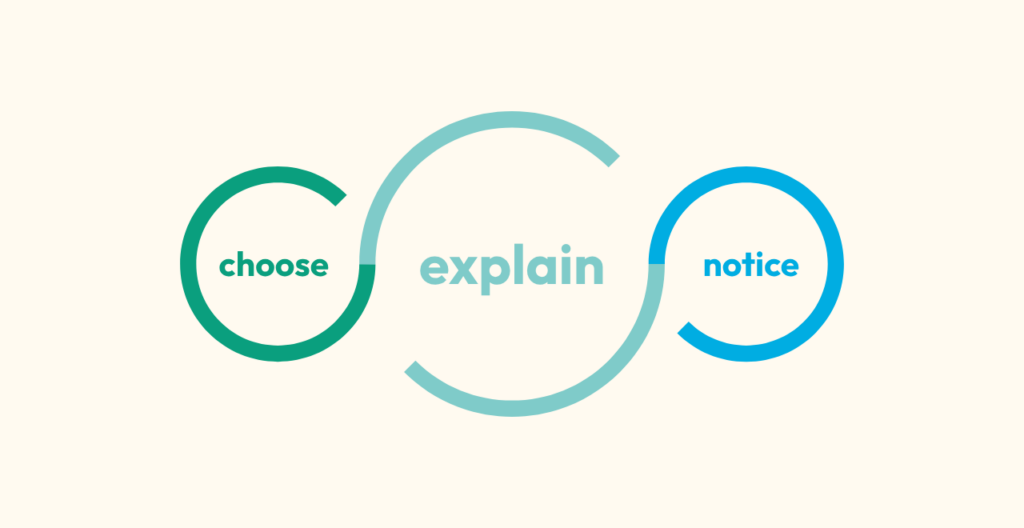
- Step 1: Pick a concept you think you understand well. It could be something from your work, a topic you discuss often, a tool you use, or an idea you’ve been advocating for.
- Step 2: Explain it step by step without looking anything up. Write it out or say it out loud as if you were teaching someone who knows nothing about it. Don’t skip the “obvious” parts. Follow the chain of cause and effect from beginning to end.
- Step 3: Notice where you get stuck. Pay attention to the moments where your explanation gets vague, where you use filler phrases like “it basically works by…” or “somehow it just…” or where you realize you’re actually restating the what instead of explaining the how. Those gaps are the illusion breaking.
That discomfort in Step 3 is the most valuable signal you’ll get because it tells you exactly where your actual understanding ends and where the illusion of clarity begins.
Confronting the illusion of clarity is not always pleasant, especially when you realize that something you thought you knew – maybe something you’ve even taught others or built decisions on – is held together by vague assumptions rather than real understanding.
But I’ve come to see this discomfort as one of the most productive feelings available to us as knowledge workers. Every time I sit down to write and hit that gap between what I thought I knew and what I can actually explain, I know I’m actually learning.