

Last week, I was invited to speak at the University of Cambridge in front of a hundred people. The talk would be unpaid, but my travel from London would be covered, and I could have lunch in the Great Hall.
Last year, I would have said yes immediately. What an opportunity to share my work and visit such a beautiful place! But this year, I promised myself I’d focus on writing my next book. A talk might only last an hour, but preparing, traveling, and getting back into writing mode afterwards would take much more time and energy.
With a major manuscript deadline next year, was it worth it? I kept going back and forth, unable to decide whether to accept or decline. We all face small and big decisions everyday that don’t seem to have an obvious answer.
A new job is exciting, but means giving up security. Moving cities promises adventure and self-discovery, but also distance from people we love. We make lists, ask for advice, and wait for clarity that never arrives. Why are some decisions so hard?
From a scientific standpoint, decisions feel difficult when our brains struggle to identify a clearly preferable option, or when choosing carries significant psychological costs. There are three main sources of difficulty:
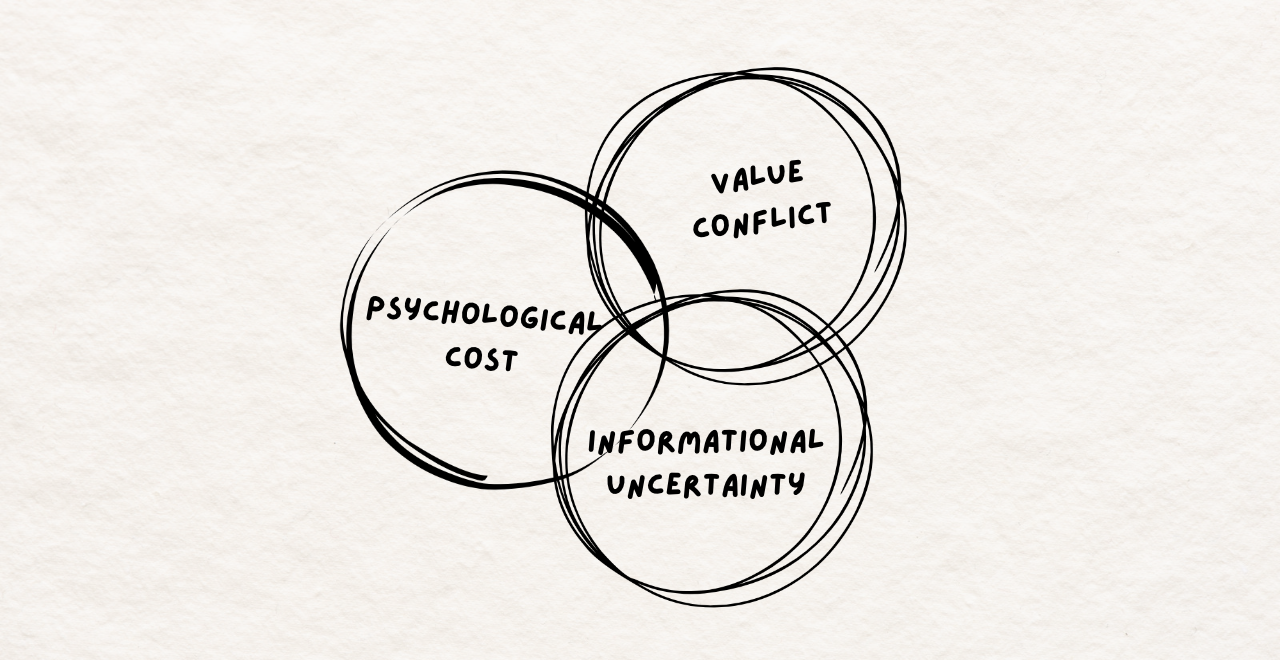
1. Informational Uncertainty – Do I know enough to predict what will happen? Perhaps you’re considering a new job but don’t know whether the company is financially stable. Or you’re thinking about moving and aren’t sure what living there would cost. Here, the obstacle is missing information. The temptation is to research everything, but research shows that more information isn’t always better. Instead, ask yourself: what’s the one missing fact most likely to change my choice?
2. Value Conflict – Which sacrifice am I willing to make? Sometimes you have all the information you need, but competing priorities pull you in different directions. A higher-paying job may offer financial security but less personal freedom. Moving closer to family may mean leaving a community you’ve built elsewhere. Neither option satisfies everything. Rather than adding more pros and cons, identify the most important criterion for this season of your life. Stability? Growth? Connection? Autonomy? Then decide which trade-off you’re willing to accept.
3. Psychological Cost – Can I live with the possibility of regret? You may know what you prefer, yet still struggle to commit. The obstacle is the discomfort of being responsible for an uncertain outcome. If you move, what if you’re lonely? If you decline the opportunity, what if it never comes again? Research on self-distancing suggests that an outside perspective can help us reason more wisely in those situations. Imagine a close friend facing exactly your situation. What would you advise them?
Most importantly, make sure to use a stopping rule to avoid endless deliberation. Do you have enough relevant information? Do you understand the priorities you’re trading off? Can you accept the responsibility and remaining risks? If the answer is yes to all three, it’s time to decide.
For the talk at Cambridge, I had enough information, and the priorities were clear: I wanted to share my work while protecting time for my book. What kept me stuck was anticipated regret. When next year’s manuscript deadline arrives, will I wish I’d guarded my time more fiercely?
So I imagined advising a friend. I probably wouldn’t tell them to hide away until the manuscript was finished. I’d suggest a smaller commitment that preserved the best part of the opportunity. And that’s what I did. I replied that I’d be happy to join for a moderated conversation, requiring much less preparation than a standalone talk.
I might still regret saying yes, but I’ve reduced the cost of the decision without losing what made the invitation exciting.
You’ll never be able to ensure you won’t have any regrets. Instead, a good decision is one that’s informed by the available evidence, aligned with your priorities, and made in acceptance of the inevitable uncertainty.