
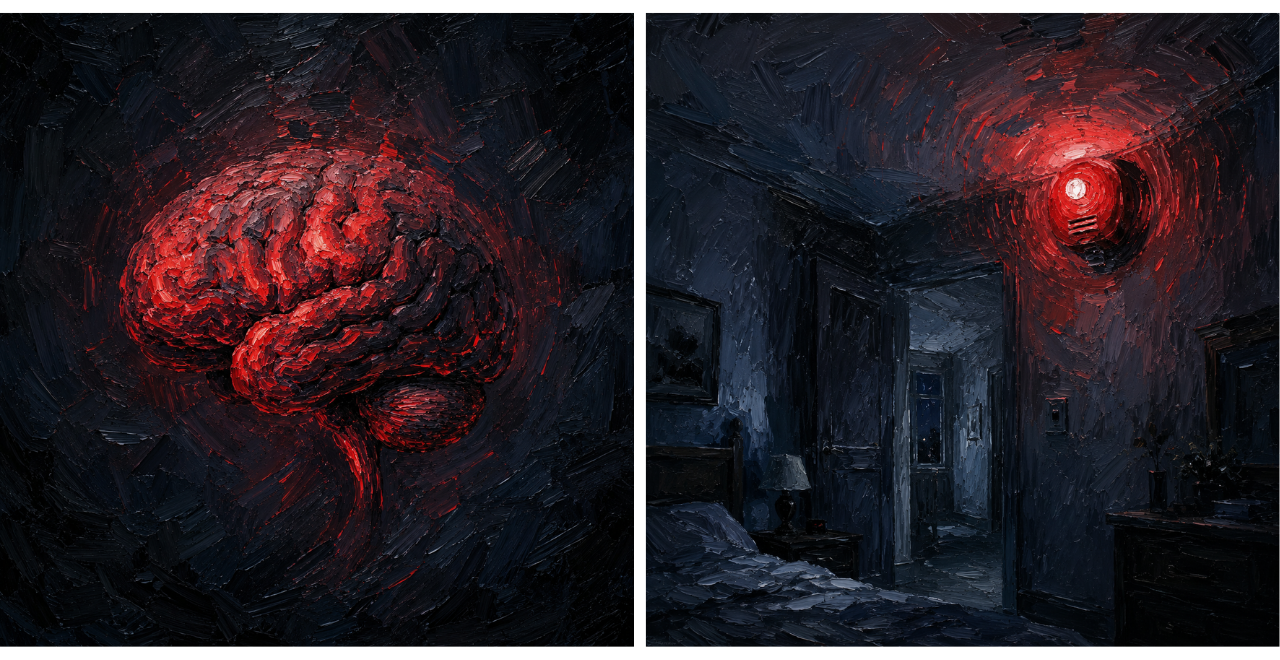
Imagine your fire alarm going off in the middle of the night.
You check every room and find no smoke, no fire, no obvious danger. The alarm is still making noise, but you have no idea what triggered it. Sometimes anxiety feels exactly like that — you know something feels wrong, but the feeling isn’t pointing at anything you can name.
The American Psychological Association describes this as free-floating anxiety: a diffuse sense of uneasiness that isn’t directed toward a specific situation or threat. You feel anxious, but you can’t quite explain why.
This can be especially frustrating, because anxiety is usually easier to manage when it has a clear cause. If you’re worried about a deadline, a difficult conversation, or a major decision, at least you know what you’re dealing with.
But when the feeling seems to come from nowhere, it’s much harder to know what to do next.
One possible explanation is that your brain is still scanning for danger even when there isn’t an immediate threat. Free-floating anxiety is believed to be linked to a hyperactive amygdala, the part of the brain involved in emotional responses and fear. Trauma and chronic stress can both contribute to this heightened state of alertness.
A lot of people are also carrying a low hum of uncertainty right now about jobs and how quickly AI is reshaping whole industries, about the economy, about the news cycle. While none of it is one nameable threat, together, it can become the kind of background noise that keeps your threat-detection system running at all times.
So even when you’re sitting at your desk answering emails or working through a routine task, your nervous system may still be primed for the possibility that something could go wrong.
The instinctive response is often to push through the anxiety. But trying to force your way through it can become another source of stress, leaving you feeling even more overwhelmed.
Instead, it helps to treat free-floating anxiety as a signal that something needs attention. Three small steps can help:
- Reset your body. Anxiety is a physical experience as much as a mental one. Stretching, taking a few slow breaths, and drinking a glass of water can help calm your nervous system and reduce some of the physiological symptoms that make free-floating anxiety feel more intense.
- Name what you’re feeling. Research has found that affective labeling, the practice of putting emotions into words, can reduce activity in the amygdala. Spending a few minutes journaling or simply listing what you’re feeling can make free-floating anxiety feel more manageable.
- Choose the easiest next step. Anxiety has a way of making everything feel bigger than it is. Focusing on the easiest task you can complete right now can help shift you from paralysis to action.
When anxiety feels disconnected from your actual circumstances and you can’t identify a clear stressor, it’s easy to assume something is wrong with you. But more often, your mind and body are responding to stress that hasn’t been fully processed yet.
You can’t (and shouldn’t try to) eliminate every anxious feeling. But you can recognize the signal and give yourself a chance to reset before moving forward. The alarm may still sound now and then. Instead of ignoring it, go check the rooms, see there’s no fire, and take the next small step.
Tiny Experiment of the Week
Ready to put these ideas into practice? Try this week’s tiny experiment:
I will [journal for 5 minutes whenever I feel anxious] for [5 days].
When you notice anxiety showing up, pause and write down a few words that describe what you’re feeling. This experiment can help turn a vague sense of unease into something more concrete and easier to respond to.
➤ Want to dig deeper? Get your copy of Tiny Experiments.