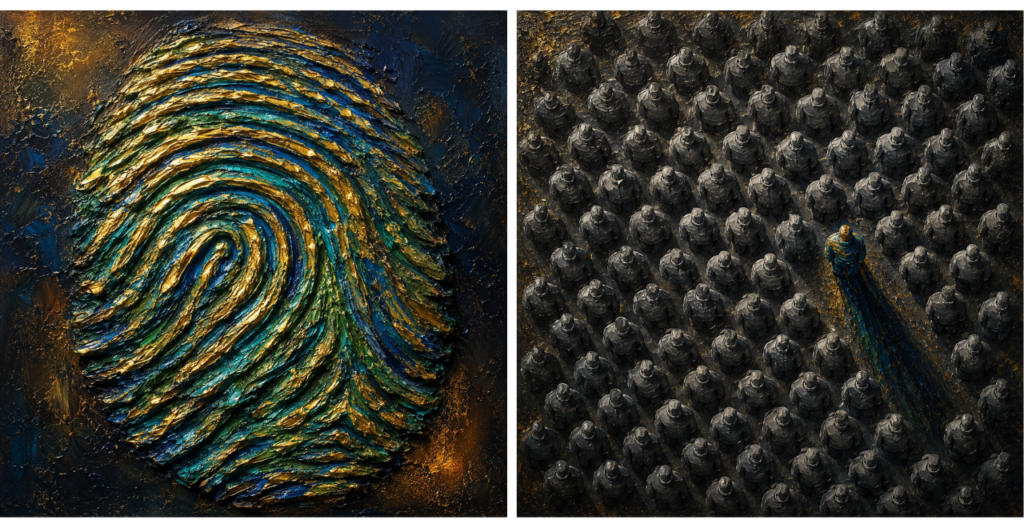
I started planning my next book, and there’s this question that keeps on nagging at the back of my mind: would an AI write it better than I could? Probably faster. Possibly cleaner. Maybe even, when I have a bad day, more beautifully.
If you make things for a living, you’ve likely experienced your own version of this. Before deciding what to do about it, it helps to know where this fear comes from.
Being replaceable threatens a few things we’re built to defend.
- Belonging. Baumeister and Leary argued that belonging is a basic human drive. The idea of being replaceable – being just one body the group could lose without noticing – is almost antithetical to the idea of belonging.
- Self-worth. Research suggests we use self-esteem, achievement, and the sense of leaving something behind to hold off the dread of our own insignificance. Knowing that you could be easily swapped weakens that protection mechanism, especially if your self-worth comes from being good at something.
- Identity. Beyond competence, we want to be someone in particular. Social identity research describes how we tend to think of ourselves as both an individual and a member of a category. “Another writer,” “another designer,” “another hire” – the more interchangeable the category feels, the less distinct our identity does.
Underneath this is older wiring. In small ancestral groups, being valuable to others had a big impact on your access to food, protection and care, so the fear of being replaceable is linked to the much deeper fear of being unsafe.
So, can you become irreplaceable? In a strict functional sense, the answer is no – nobody is irreplaceable. But you can become hard to substitute. I think of it as the Triple T:
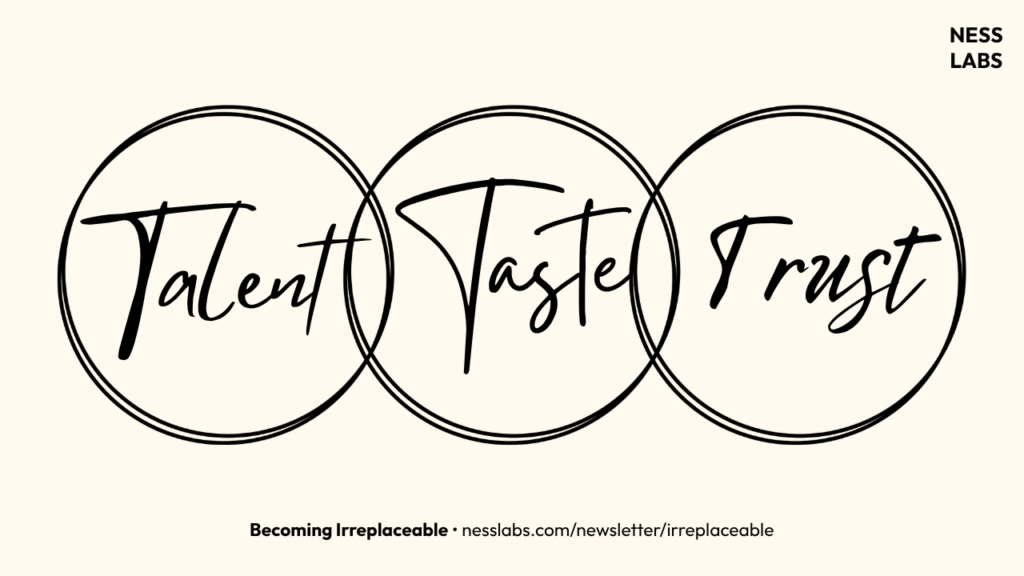
Talent. Bet on a rare combination of skills. A brilliant illustrator can be replaced by another brilliant illustrator, but a brilliant illustrator who also understands strategy, audience, and client politics is much harder to replace. And favor work that compounds such as writing, teaching, creating frameworks and documenting how you think so your unique combination of skills becomes increasingly visible instead of resetting with every new project.
Taste. What to keep, what to cut, what risk is worth taking… Knowing all this comes from lots of exposure and lots of reps. While a style can be copied, it’s much harder to copy a coherent point of view. In modern creative work especially, producing the thing is rarely the bottleneck – knowing what’s worth producing is.
Trust. When the work is hard and the outcome uncertain, the job tends to go to whoever is already trusted to handle it. That trust comes from seemingly unremarkable things such as doing what you said you would, raising problems early, and staying calm when a project wobbles. It’s worth investing in your relationships and not just your portfolio as this kind of social capital can become a real asset.
Again, the Triple T raises the cost of swapping you out but it doesn’t make you absolutely irreplaceable. To tame the anxiety of being replaced by a new person or a new technology, I find Hannah Arendt’s idea of plurality very helpful.
The idea is that we’re equal in being human and distinct because no two people carry the same biography, vantage point, and place in the world. Although you aren’t strictly necessary, your particular experience won’t recur.
Simply put, you can be replaced as a function, but you can’t be repeated as a life. I find this to be reason enough to do the work as only you would, and to look after the dignity and responsibility that come with it.
My next book might be writable by a machine, but the version only I can write isn’t.
Tiny Experiment of the Week
Ready to put these ideas into practice? Try this week’s tiny experiment:
I will [publish one small framework once a week] for [6 weeks].
This can be a mental model, a quick rule of thumb, a phenomenon you found to be true in your industry. You can publish it on LinkedIn, in a newsletter, or in a short internal memo. This experiment will help you build skills, develop your sense of what works, and build trust with others by learning in public.
➤ Want to dig deeper? Get your copy of Tiny Experiments.