Welcome to this edition of our Tools for Thought series, where we learn from founders on a mission to help us think and live better. Oleksandr Matsiuk is the founder of RiseGuide, an expert-powered app that gives you a clear and personalized plan for self-improvement.
In this interview, we discussed why expert-led learning is so powerful, the role of stories and role models in self-improvement, how practice-based learning helps people apply ideas in daily life, the challenge of information overload in self-improvement, why consistency isn’t a willpower problem, how microlearning can fit into busy adult lives, and much more. Enjoy the read!
Hi Oleksandr, thank you for joining us. You’re building RiseGuide around the idea of expert-powered self-improvement. Why do you think learning from experts is so powerful?
I’d start with a simple observation: people trust people more than they trust brands or institutions. This isn’t just my intuition. Nielsen’s Global Trust in Advertising study, which surveyed 40,000 people across 56 countries, found that 88% of consumers trust recommendations from people they know above all other forms of messaging. Edelman’s research shows a similar pattern: people now trust “someone like me” as much as they trust scientists. So when we talk about learning from experts, we’re working with how human trust is actually wired. Next I want to share the other 3 reasons I believe learning from experts in modern times make so much sense.
The first is skin in the game. When an expert teaches under their own name, their personal reputation is on the line, so they thoroughly check every piece of work they put out there. A brand can retire a bad course and move on, but a person usually suffers greater reputational damage – their integrity could be at stake. If someone like Charles Duhigg gives poor advice, it usually backfires. That pressure produces a different quality of knowledge. I spoke about this recently in the context of AI: a person who has done the thing they’re teaching went through years of work, paid for their mistakes, and built their knowledge with real consequences attached – something AI can’t possibly compete with.
The second is inspiration. A real expert doesn’t just transfer their knowledge to you, they set an example. When you see how someone went from where you are now to where you want to be, your brain starts to believe: if they pulled it off, maybe so can I. Nowadays, with everything competing for our attention, that spark of inspiration is oftentimes more valuable than the specific tactic.
The third is relatability. It’s simply easier to form a connection with a human than with a brand or organisation. I experienced this myself long before RiseGuide existed. I was always fascinated by biographies of remarkable people. I’d read their quotes, watched their interviews, and studied how they explained their path and failures. Those people taught me more than any school ever did, just because the connection was personal. You can model yourself on a person; “if they did it, so can I.”
I do think that learning from experts only works if you go beyond admiring them though. Oftentimes, we put famous people on a pedestal, and start admiring their charisma and personality overlooking their professional flaws or gaps in their teachings. The value experts provide comes down to taking their playbook and running it in your own context, making your own mistakes, and adjusting.
Skin in the game, specificity, relatability. That makes sense. Taking a step back, how did you come up with the idea for RiseGuide?
The honest answer is that the idea was probably forming for most of my life before I recognized it as a business.
As a kid I was a history geek. What pulled me in wasn’t dates or battles but the key figures shaping the history. Napoleon, for instance – an underdog who changed the world without any obvious starting advantages. That fascination never went away, it just changed shape in my adult life. When I look back at my professional path, the pattern is the same: the biggest lessons that shaped me as an entrepreneur rarely came from textbooks or corporate tutorials, but from the inspiring people all around me. I had a tennis coach as a kid who drilled simple things into us until we did them noticeably better than everyone else. Even if at the time I hated it, I know that thanks to his approach, the lesson stayed with me years later.
The business side caught up when I was building my previous company, Trible. We were building a star factory of sorts, a platform helping content creators grow their presence and business online, monetise their talents. Working that close to the creator economy, I kept running into the same gap: the most valuable knowledge belongs to top experts and role models, and it’s scattered across thousands of hours of interviews, books, and podcasts that almost nobody gets through. I wanted to aggregate it, break down how these people achieved what they achieved, interpret it, and make it usable. It felt like a strong format the market was missing. When we sold Trible, that idea became RiseGuide.
There was also a more personal trigger. I’m probably an unusual founder for a mobile app, because I didn’t own a smartphone until 2017 – I deliberately walked around with a button phone to preserve my attention span and avoid distractions. And even with that level of awareness, the moment I finally got a smartphone, I fell down the scrolling rabbit hole just like everyone else. I started reading less, learning less. That experience convinced me that restriction doesn’t really work, with phones or with any other addiction. Substitution does. The people building social media are very good at making products addictive, and I don’t blame them, it’s their job. But I kept coming back to one question: why can’t learning use the same principle in understanding human wiring? Why does scrolling always have to end in guilt?
Finally, I just love teaching and sharing knowledge. Education is my true passion, and I sincerely believe it’s one of the best ways a person can contribute to society. I taught entrepreneurship basics at Genesis Academy, a school for top tech talent in Ukraine, and I’d regularly stay until 10pm because I genuinely enjoyed answering every last question. When you explain something to another person, you learn it twice. Education is what I want to spend my life on, in one form or another, and RiseGuide is the current form: expert knowledge, delivered in a bite-sized format that’s engaging enough to win minutes back from social media. We launched in 2024, built SEEK (our expert knowledge search engine) a year later, and today we’re at over 400,000 monthly active users. The product keeps evolving, but the core idea is still there since the Trible days.
Can you tell us more about the research behind RiseGuide?
We covered the expert side already, so let me talk about the other two pillars, because the research behind them shaped the product more than people might expect.
The second pillar is being practice-oriented. The honest problem with self-improvement was never a lack of information – we have far too much of it. It’s that consuming knowledge feels productive in the moment but rarely changes what you do when a real situation shows up. Researchers at Harvard and Stanford even have a name for it, the “knowing-doing gap”: we watch the course, save the article, nod along to the podcast, and then in the actual meeting fall straight back into old habits.
What works is generating something yourself instead of just absorbing it – there’s solid research on the “generation effect”, where people who produce information after reading remember it far better than those who only re-read. So we built RiseGuide around doing, not watching.
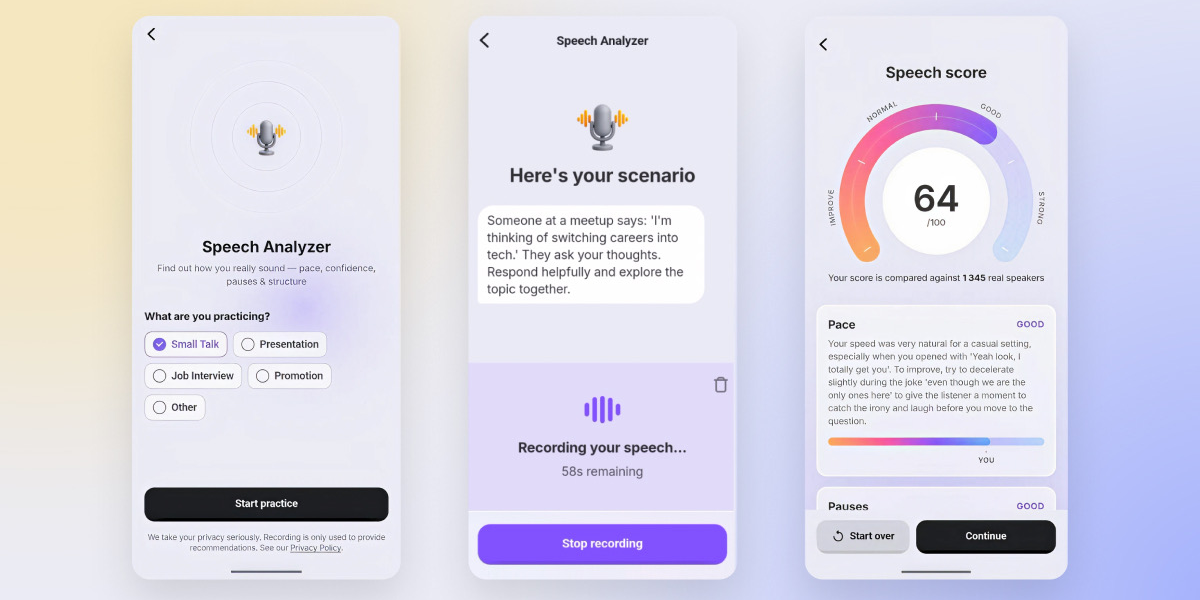
For instance, to improve in your professional communication, you study a lesson on how strong communicators structure arguments – and then go and apply that framework in your next meeting. For memory training, instead of memorising random sequences, you practice encoding techniques on information you actually need in your real life – names, presentation points, reading material.
The third pillar is being “micro”, and here the research we looked at was all around the addictive social media playbook. I have no illusions that people will stop scrolling in future. As I’ve seen in my own life, restriction doesn’t really work with any addiction – substitution is what’s required. And if we want to win minutes back from TikTok, streaming, and video games, we’d be naive not to use their own already proven tactics: short vertical format, faster pace, variety of content, gamification, personalisation. The people building those products and algorithms nowadays understand human wiring very well, and there’s nothing stopping learning products and the education industry from applying the same understanding to something more useful.
There’s also a more boring reason why micro wins, and it comes from watching our users: completion beats volume. A small course that a user finished does more for them than a long course they bought and abandoned. The statistic my team keeps coming back to is the 5% industry standard for long course completion – pretty drastic, if you ask me. Fifteen minutes a day sounds modest next to a three-hour masterclass, but the person doing fifteen minutes is very likely still there on day twenty. Consistency is usually the name of the game, and we need to work around how a modern adult learns and retains information – not fight it.
A lot of people want to improve themselves, but they struggle with information overload or inconsistency. How do you address these challenges?
What’s interesting is that these two problems feed each other. When there’s too much advice, people feel overwhelmed, jump between sources, struggle to stay on one path, and then blame themselves for being inconsistent. So we treat them as one problem, really.
With overload, I think the issue isn’t really finding advice out there – it’s telling good advice from just noise. You search “how to be more confident” and you get a TED talk, a random blogger who went viral, a 19-year-old influencer repackaging someone else’s book, and somewhere on page two, a person who actually spent twenty years on the subject. They all sound equally sure of themselves.
Tony Robbins has this idea I keep coming back to: if you want a certain result, find someone who already achieved it and study what they did. It’s a simple filter, but it cuts out most of the noise. And there’s a side effect people underestimate – when advice comes from someone who visibly walked the path, you believe the path leads somewhere. That belief is oftentimes what carries you through the boring middle stretch of learning.
Inconsistency, if you ask me, is usually a design problem, not necessarily a character flaw. Around 53% of Americans say they want to cut their phone time, and only 10-12% manage to stick to strict limits. People don’t lack willpower, they lack a format that fits their real day.
So knowing all this, RiseGuide leans on two things. Tangible progress – when you try a technique in a real conversation the same day and it works, that pulls you back tomorrow much harder than discipline ever would. And low friction – the lesson has to fit into the same little pockets of the day where you’d otherwise typically scroll social media: in a queue, on a commute, or on a tired evening after work.
That’s great. Now, who exactly is RiseGuide designed for?
Our core user is probably older than people would guess for a self-improvement app – around 40. Three quarters are working professionals, mostly white-collar (managers, specialists, executives), around 60% are women, and the majority are based in the US, UK, and other English-speaking and EU markets.
Beyond the demographics, two things usually define them. First, they’re active smartphone and digital media users, and they feel guilty about it – about the hours going into feeds while their potential sits untouched. Second, they’ve already tried some form of self-help before us: a half-read book, a long course they abandoned, motivational videos. The desire to grow is there. What they’re looking for is a clear path and a format that fits a working adult’s schedule – typically to improve their communication, confidence, or cognitive skills for very practical reasons: leading meetings, negotiating, staying sharp through a long workday.
Let’s talk about how RiseGuide works in more detail. What does the experience look like for a new user?
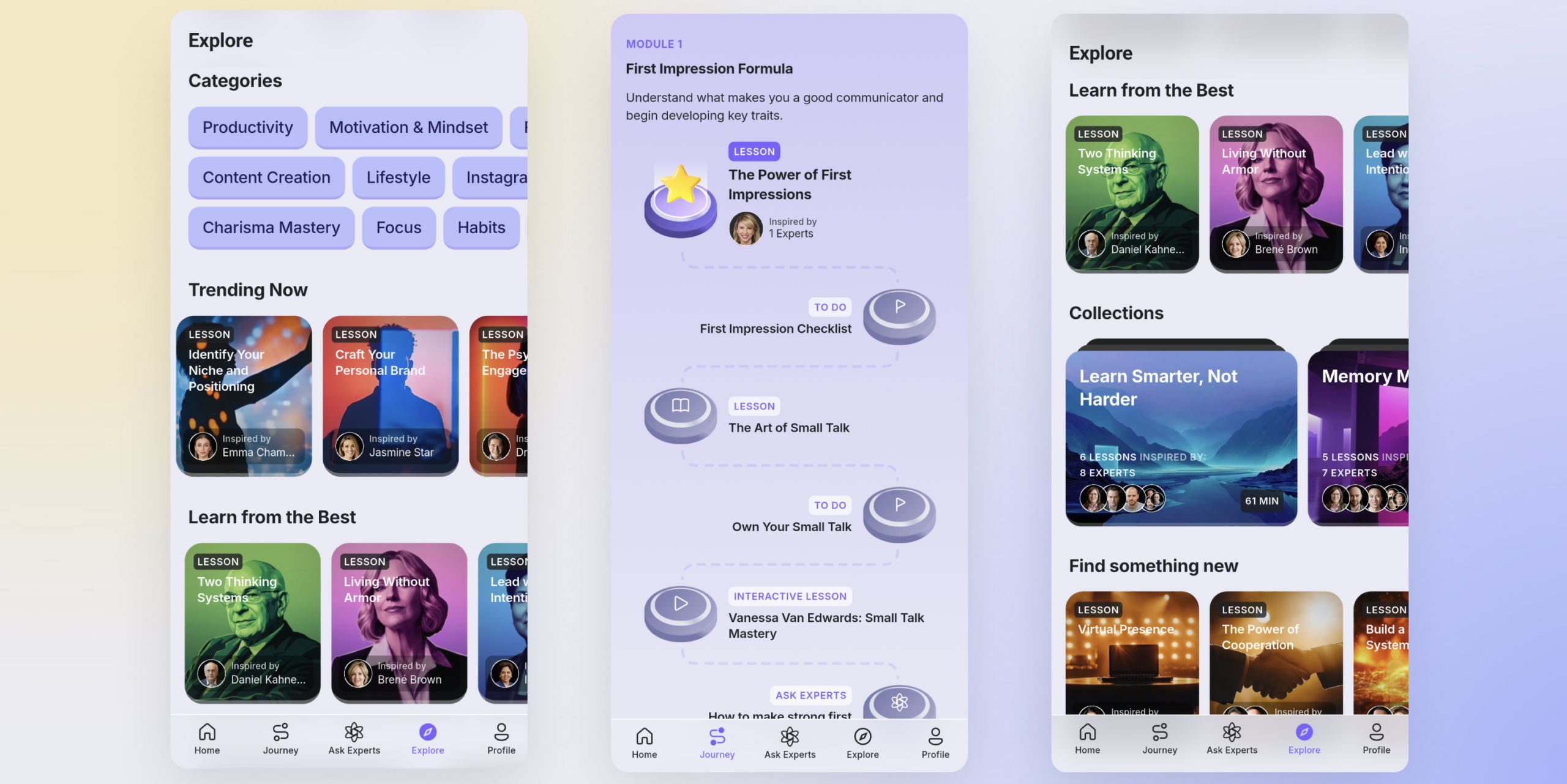
It starts with a short quiz. We ask about your goals, where you feel stuck, what you want to improve, and also which famous experts already inspire you – and based on that, the app tailors a personalized learning journey for you. Someone who wants more presence in meetings might land in Communication Mastery, someone worried about brain fog goes towards Intelligence Training.
We deliberately don’t push people to binge the content – we learned that seeing forty lessons at once mostly produces anxiety, so the journey is delivered in manageable daily chunks on your Home page. Each day you get a 7-10 min lesson mix built around one specific learning outcome you’re working towards. It’s usually a combination of formats: a bite-sized lesson, a practice exercise, maybe a SEEK session where you dig into a question with answers from vetted experts, or an interactive story/video or case study where you make choices and see where they lead.
The variety is intentional – different formats reinforce the same skill from different angles, and honestly, it also keeps the experience from feeling like homework for our users.
As we already discussed, the practice part is where the progress happens. Lessons usually end with a to-do that leaves the app: try this framework in your next conversation, use this technique on something you need to remember anyway. Day by day these small applications stack up. This content diversity helps to achieve better learning outcomes and keep interest high.
Can you tell us more about SEEK, your search engine for expert knowledge? How does it work, and what problem were you trying to solve with it?
SEEK grew out of a limitation we saw in our own lessons. A lesson gives you a broad overview of a topic and establishes the context – and oftentimes that’s exactly what people need first, because many of us don’t even realise we have a certain problem, or what solutions exist for it, until somebody points at it. But once that context is there, different users want to go deeper in very different directions. One person finishing a communication module wants to handle interruptions in meetings, another wants small talk tips for a conference. No fixed curriculum can cover every branch, so we built SEEK to personalise the experience further and answer those specific questions directly.
The way it works: we hand-pick every expert and every source that goes into the closed-loop internal library – currently it’s over 300 vetted experts and more than a thousand hours of their content. You ask a question in plain language, and SEEK pulls the relevant insights from that library, with direct links to the original sources, so you can watch the expert explain it themselves. We’re already over a million searches in, and honestly that tells me the need for specific answers was even bigger than we assumed!
And the difference from general search or generic AI chatbots is the boundary of the library itself. As I’ve seen with AI tools so often lately, the answers can sound very confident while being hallucinated, and you rarely understand what they’re based on unless you dig in the sources (most people won’t).
Regular internet search has the opposite problem – everything is there, including advice from people who shouldn’t be giving it. SEEK only searches within content we’ve verified, nothing from the open internet. For self-improvement specifically, I think that matters a lot, because you’re going to act on these answers in your real life, in your career, in your relationships.
There’s also a nice side effect we didn’t fully plan for: SEEK became a discovery tool. Users find an expert through one answer, then go off and watch their full lecture or read their book on their own. We’re quite happy when that happens.
That sounds great. What are some of the main ways people are using RiseGuide today?
We’re going after the most popular and critical self-improvement topics and areas one by one – charisma and communication, intelligence and memory, habits and productivity, emotional intelligence, personal branding. The selection comes from my team who analyse social media and search trends, surges in book sales, even academic publications, to see where the demand is currently concentrated. So the range of topics isn’t wide yet, but that’s deliberate.
Each of these areas is huge on its own, and we’d rather go deep on quality than spread across twenty shallow categories. You can genuinely study and train charisma or intelligence for months. And that’s what we observe in the data – the majority of our users stay within one topic for a long time and rarely jump around.
How people use the app day to day is far more varied. Some would binge the content like a series and barely touch the practice. Some rigorously follow the exact flow we envisioned – lesson, exercise, to-do, repeat. And some skip the content almost entirely and double down on training and SEEK, treating the app as a gym rather than a library.
We also see almost equal shares of watchers and listeners – plenty of people consume lessons audio-only, somewhere between a podcast and a course. My view on this is fairly relaxed: our job is to provide the means for growth in every available format, and then let people decide how they learn best. The envisioned flow exists for a reason, but I’d rather have someone use the app “wrong” every day than not use it at all.
What about you, how do you personally use RiseGuide?
I’m a morning learner. Starting the day with self-improvement and a little bit of mental struggle instead of doomscrolling sets the tone – I stay noticeably more focused and productive after it. So my 15 minute session usually happens during breakfast or morning coffee, before the meetings take over.
Apart from that, I’m probably one of our heaviest SEEK users. During my commute or wind-down walks I queue up a sequence of questions – whatever has been on my mind that week, a management situation or even a tough negotiation coming up – and then listen to the answers back to back, like a podcast that was assembled personally for me.
It’s a very different mode from the morning session – less structured, more driven by whatever problem I’m actually carrying around that day.
Looking ahead, how do you see RiseGuide evolving over the next few years?
We’ll definitely keep expanding the content library and the range of self-actualisation topics and adding more diversity in formats along the way. We already have interactive video lessons where you choose different paths and the story branches, a bit like Netflix interactive films or games like Detroit: Become Human, and users usually come back to replay different timelines. There’s a lot more we can do in that direction.
My ambition is that every learning unit in RiseGuide contains a tool, an interactive element, or an exercise. We’ve talked about why passive consumption rarely changes people, so we want to hold every piece of our own content to that standard.
We’re also slowly building towards gamification and community as support mechanisms on the learning journey. Most people drop off somewhere in the middle of building a skill, when the novelty is gone and the results haven’t fully arrived yet. Making progress visible helps with that, and so does seeing other people walking the same path – we’re social creatures, and nothing pulls us along quite like others.
And the one I’m personally most excited about is partnering with top experts and role models to create exclusive microlearning content directly on RiseGuide. Today we curate and distill what experts have already published. The next step is designing lessons together with them, natively for our format – bite-sized, interactive, practice-first – instead of adapting content that was originally a book or a two-hour lecture.
Thank you so much for your time, Oleksandr! Where can people learn more about RiseGuide?
Thank you! You can visit our website, or follow us on Instagram, Medium, and LinkedIn for updates.