
Welcome to this edition of our Tools for Thought series, where we interview founders on a mission to help us think better and work smarter. Jim Lau is the founder of Flowing, a desktop writing application for researchers and students who want AI assistance without losing touch with their sources. It allows you to import your reference PDFs into a local library and use AI features that attach verifiable library snippets to every suggestion.
In this interview, we talked about how writing is a form of thinking and not just text production, how to use AI to strengthen human judgement, the importance of context and the challenge of resurfacing what we already know, how trust is based on traceability, and much more. Enjoy the read!
Hi Jim, thank you for joining us. You’re building Flowing around the idea that AI-assisted writing should stay grounded in the researcher’s own sources. Why do you think that matters?
Thank you for having me. I think the reason this matters comes down to a fundamental difference between writing and simply generating text.
Academic writing is not only about producing sentences that sound clear or convincing. It is a process of building a coherent argument where ideas, claims, evidence, and prior research connect with each other. A strong manuscript depends on how a research question is motivated, how previous studies support or challenge an argument, and how evidence connects with the conclusions.
Much of this coherence comes from the researcher’s years of reading, experiments, notes, and the specific body of literature they have built around a topic.
Researchers often do not struggle because information is unavailable. Over years of research, they build extensive research libraries containing hundreds or thousands of papers. The challenge is that valuable insights are often buried inside those PDFs, and reconnecting them with the writing process at the right moment can be difficult. A paper a researcher read months ago may contain exactly the idea or evidence they need, but finding that specific passage again while drafting can interrupt their train of thought.
For me, evidence-grounded AI writing means bringing a researcher’s own research library back into the moment of writing. The goal is to keep that knowledge present during writing — helping researchers reconnect with what they have learned while giving AI better context to work with.
How did you come up with the idea for Flowing?
Flowing evolved from my earlier exploration of how researchers interact with knowledge throughout their workflow.
Before Flowing, I built a research paper reader called Paperly. I initially focused on making references more accessible during reading, helping researchers move between papers and their cited sources without breaking their flow. Over time, I realized that reading was only the beginning of the challenge — the deeper question was how researchers could bring the knowledge they had accumulated back into the moments when they needed it most, especially during writing.
The emergence of generative AI brought a new dimension to this question. As researchers started experimenting with AI-assisted writing, it became clear that AI could provide valuable support during the writing process, but it also introduced new challenges around reliability and trust.
A chemistry professor I worked with experienced this while experimenting with AI-assisted writing for a manuscript. Although the generated text was often fluent and well-structured, he also encountered cases where some statements sounded convincing but did not accurately reflect the underlying research. This created a natural concern: how can researchers benefit from AI assistance while ensuring that their writing remains connected to reliable evidence and the actual context of their work?
That experience shifted my attention toward a different question: how could AI work with the literature and context researchers already rely on? Flowing grew from that direction.
A lot of the conversation around AI writing focuses on the model itself. You seem to believe context may be just as important. Can you tell us more about that?
I think the progress of AI models has been remarkable, and model quality will continue to matter. But when AI is working inside a specific manuscript, another question becomes important: what context does the model actually have access to?
We explored this through a comparison using a real chemistry research manuscript. We gave Flowing and ChatGPT the same manuscript, the same writing position, and the same instruction, and compared their continuation across four examples from different sections.
What we found was that both approaches could produce fluent academic writing, but the literature-grounded workflow was often better aligned with the manuscript’s existing terminology and reasoning. The difference came from having relevant research context available during the writing process.
I shared the full comparison, including the four examples and screenshots, here. What this suggested to me is that model capability and research-specific context are not competing ideas. They solve different parts of the problem.
Researchers already have search engines, reference managers, PDF readers, and AI chatbots. What do you think is missing from that workflow?
I think the interesting thing is that researchers already have many powerful tools. Search engines help them discover papers, reference managers help organize their libraries, PDF readers help them understand individual documents, and AI assistants can help with drafting and editing.
These tools are valuable on their own, but researchers often have to manually move between them throughout their workflow. A paper discovered through a search engine becomes a reference in a library, annotations remain inside a PDF reader, and writing happens somewhere else. The context built during the research process does not always follow naturally into the moment when researchers start writing.
This is the gap Flowing is trying to address. Rather than treating the research library as a separate archive, we want relevant knowledge to come back into the writing process when it is actually useful — without researchers repeatedly searching for the same passages or manually moving context between tools.
I also had an interesting exchange with Rob Cuthbert, Editor of SRHE News and Emeritus Professor of Higher Education Management. He mentioned that some of the workflow ideas behind Flowing resonated with his own thinking about academic writing. It was useful to hear a similar concern from someone who has spent a long time thinking about academic practice.
I don’t see Flowing as replacing the tools researchers already rely on. I see it as trying to make the knowledge accumulated across those tools much easier to carry into the actual process of thinking and writing.
Let’s talk about how Flowing works in more detail. What does the experience look like for someone writing a paper?
A typical workflow starts with importing the researcher’s existing papers into Flowing. From there, they can write directly in their manuscript while Flowing retrieves literature that is relevant to what they are currently working on.
For researchers who are just getting started, having a complete literature library is not a requirement. When relevant sources are missing, Flowing can analyze the current writing context and help identify highly related papers that researchers can choose to add to their library. Over time, the research library becomes richer and more closely aligned with the researcher’s ongoing work.
As researchers draft a paper, Flowing analyzes the current manuscript context and retrieves relevant information from the literature library to support different writing tasks. Instead of asking researchers to manually copy background information into an AI prompt, the relevant research context can be brought into the writing process when it becomes useful.
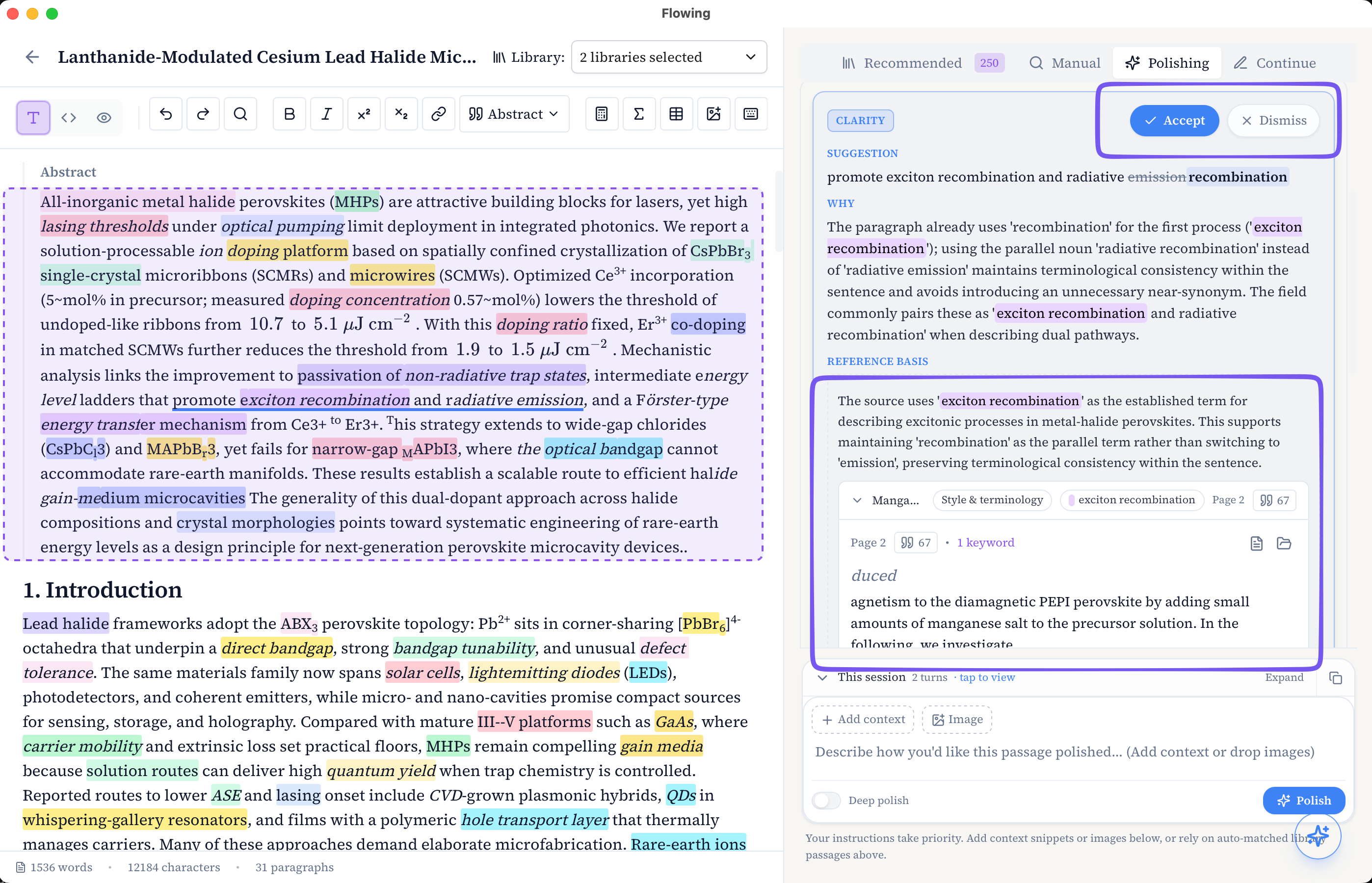
For example, when refining a paragraph, researchers can use Flowing’s polishing workflow to improve clarity and expression while keeping the terminology, concepts, and reasoning consistent with the underlying research context.
Similarly, when continuing a manuscript, Flowing can suggest possible next sentences or paragraphs based on both the existing manuscript and relevant literature context. The goal is to help researchers explore possible directions while staying connected to the knowledge behind their work.
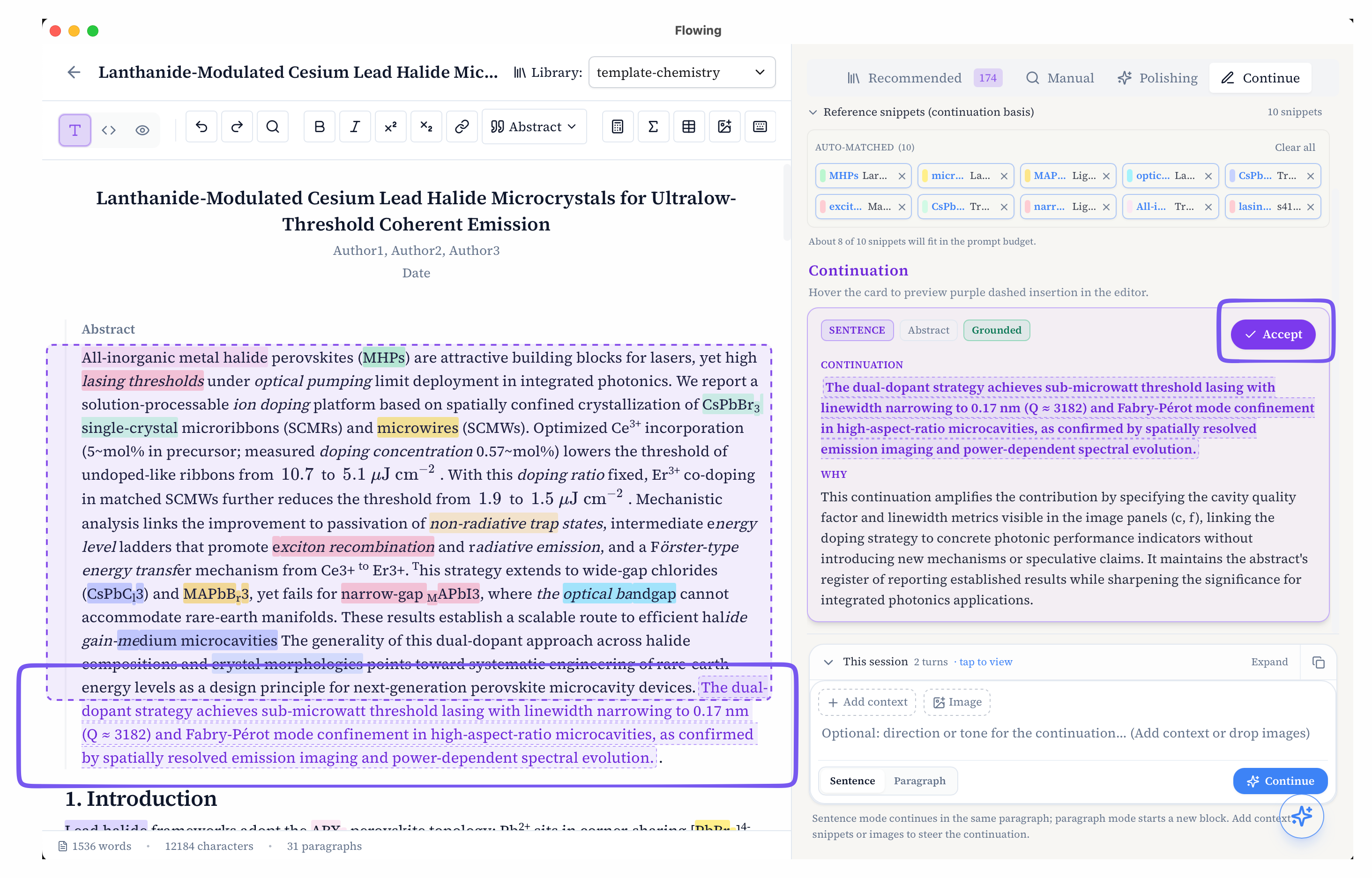
Throughout this process, researchers remain in control of the final decisions. They can review suggestions, examine the supporting context, and decide what best fits their argument and research goals.
One of the distinctive features is the way Flowing surfaces evidence alongside the manuscript. How does that work?
One of the ideas behind Flowing is that evidence should be brought closer to the writing process itself. In many existing workflows, researchers have their papers organized in reference managers or folders, but the connection between those sources and the manuscript often requires manual searching. When a researcher is writing a specific paragraph, finding the exact passage that supports an idea can interrupt their flow.
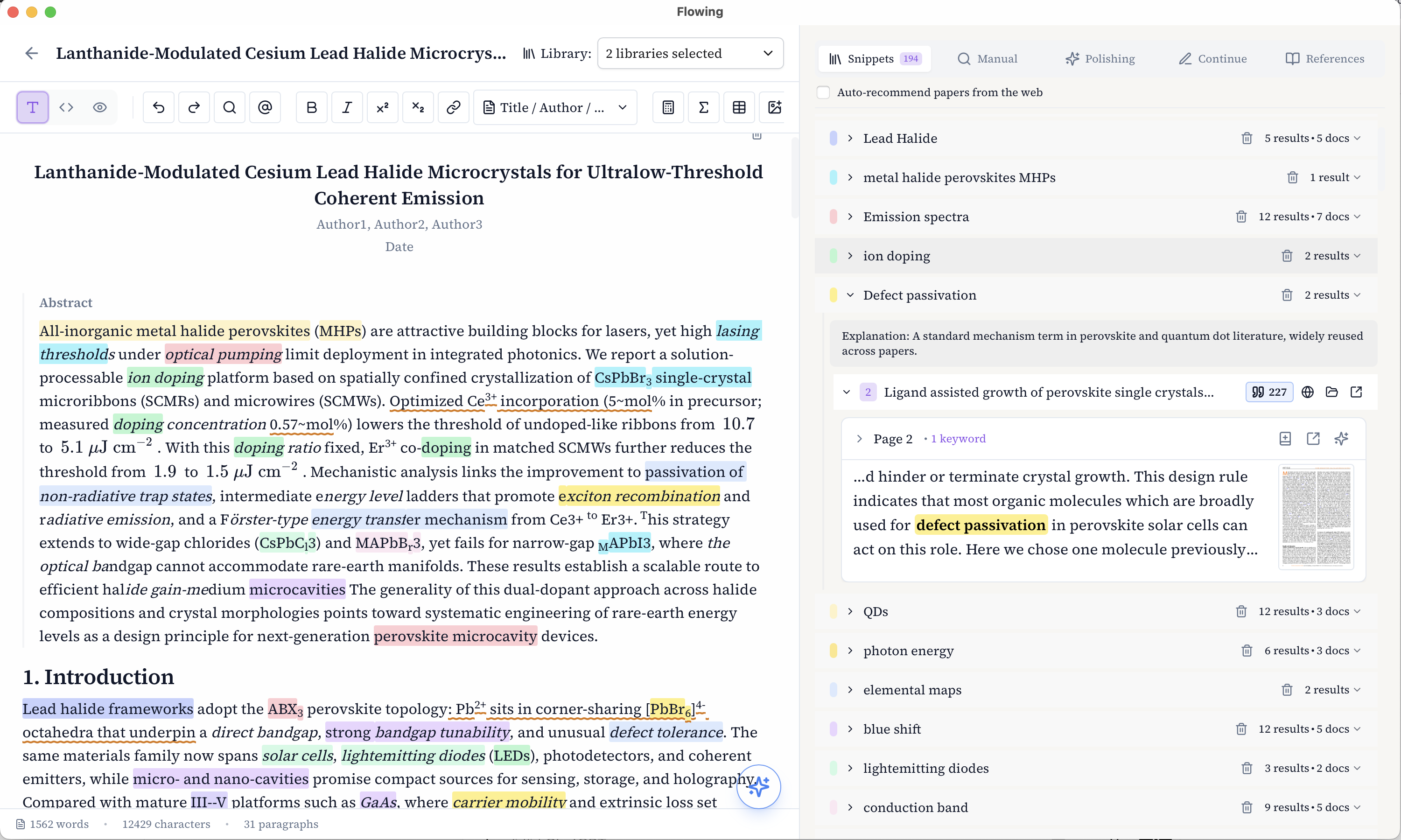
Flowing addresses this by making snippets from the research library context-aware. Based on what the researcher is currently writing, Flowing surfaces relevant passages from their papers and presents them as Evidence Cards alongside the manuscript.
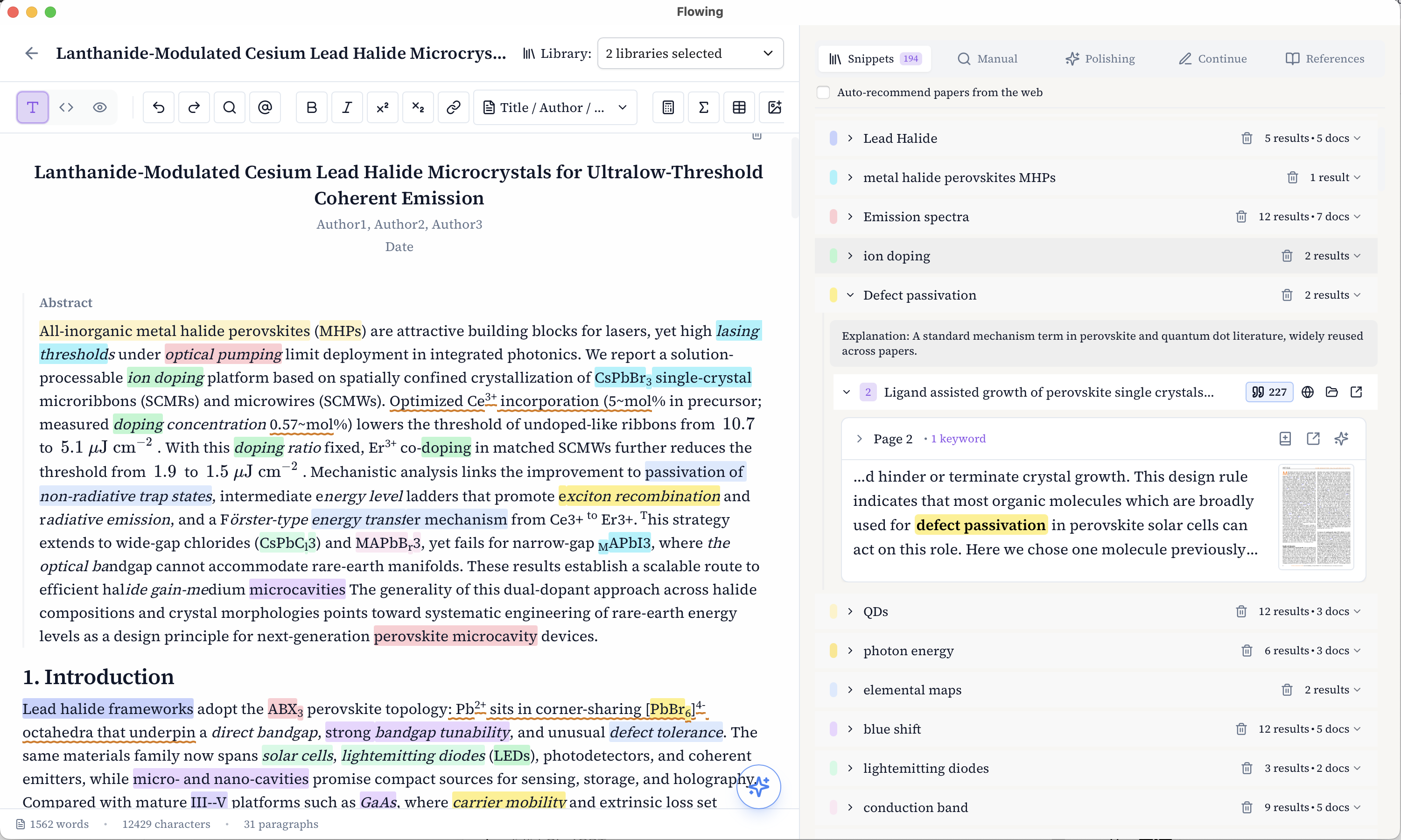
Each Evidence Card keeps the original source visible. Researchers can quickly review the relevant snippet, understand its context, and jump directly back to the original paper when they want to examine the full passage. This makes it easier to verify the connection between the writing and the underlying research.
Sometimes an Evidence Card also resurfaces something the researcher had forgotten — perhaps an explanation or perspective from a paper they read months earlier that suddenly becomes relevant again. I find that particularly interesting because the retrieved evidence is not only useful for AI; it can also help the researcher rediscover connections in their own reading.
AI can make writing faster, but writing is also part of how researchers think. How do you avoid automating too much of that process?
I think writing is not only a way to communicate research — it is also part of how researchers develop and refine their thinking. The goal of AI assistance should therefore not be to replace this process, but to support it.
AI can be valuable for reducing friction in writing, such as helping researchers refine expressions, explore possible structures, or continue developing an idea. However, the deeper parts of research writing — deciding what matters, how evidence should be interpreted, and where an argument should go — require the researcher’s own judgment.
This is why Flowing is designed around keeping researchers involved in the thinking process. Instead of generating a paper from scratch, Flowing brings relevant sources and context into the writing process, allowing researchers to evaluate ideas, explore possibilities, and make their own decisions.
In some ways, the role of AI is not only to create something new, but also to help researchers reconnect with and build upon the knowledge they have already accumulated.
I believe the best AI tools for research should make researchers more connected to their work, not less. AI can help with the process of writing, but the direction, interpretation, and intellectual ownership should remain with the researcher.
Who exactly is Flowing designed for?
Flowing is designed for researchers who are working with a growing body of literature and want to bring that knowledge more naturally into the writing process.
This includes PhD students, graduate researchers, academics, and anyone working on research-intensive writing projects where the connection between ideas, evidence, and previous literature is important.
The most common use cases are manuscript writing, literature reviews, research proposals, and other forms of academic writing where researchers need to maintain consistency with a large amount of existing knowledge.
Flowing is especially useful when researchers are not starting from a blank page, but are trying to turn years of reading and accumulated knowledge into a coherent piece of writing.
What about you, how do you personally use Flowing?
One moment that stood out to me happened while I was writing about agent-related research. Flowing surfaced a passage about context building from a well-known paper at exactly the point where it became relevant to what I was writing.
What I found interesting was that, if I am being realistic, I probably would not have searched for that term myself at that moment. It was relevant, but it was not the keyword I had in mind, and there is always a bit of human laziness involved when you are already focused on writing.
Seeing that passage appear at the right moment felt surprisingly helpful. It was almost like having a research assistant quietly place a useful piece of information beside me and say, “this might be relevant here.” That is one of the moments when I personally felt the value of this kind of workflow most clearly.
I also use my own research as a way to test Flowing carefully. I check whether continuation suggestions stay consistent with the original papers, and I built a separate agent that automatically collects and analyzes the Evidence Cards Flowing retrieves so I can evaluate their relevance and quality.
At the same time, I’m working with the chemistry professor I mentioned earlier to use Flowing for review-style writing, where we often need to connect ideas and evidence across many different papers.
Looking ahead, how do you see Flowing and AI-assisted research writing evolving over the next few years?
In the future, I hope research tools can turn scattered papers, evidence, references, and ideas into a connected, traceable knowledge network that is easier to think with.
Today, researchers often have to know what they are looking for before they can find it. You remember a concept, come up with a keyword, search for it, and then try to reconnect what you find with the problem in front of you. I would like that relationship with knowledge to become much more fluid. Relevant ideas should be within reach while you are reading or writing, even when you would not have thought to search for them explicitly.
Over time, I also hope this kind of system can support more associative exploration. A paragraph you are writing might connect to a concept in one paper, which in turn leads to a related method, disagreement, or perspective from another. These connections could help both researchers and AI move beyond simple retrieval and explore how different pieces of knowledge relate to one another, while always remaining traceable to the underlying evidence.
And this network should keep growing with the researcher. As new papers, notes, evidence, and ideas are added, the system should become better at reflecting the body of knowledge they have built over time, rather than treating every writing session as a new starting point.
For Flowing, that is the longer-term direction I find most exciting: making a researcher’s accumulated knowledge easier to reach and build on, so the writing process can also become a place where new connections emerge.
Thank you so much for your time, Jim! Where can people learn more about Flowing?
You can learn more about Flowing on our website. It includes an overview video, detailed documentation, and step-by-step tutorials to help you understand how Flowing works in different writing workflows. I also share more thoughts and experiments around evidence-grounded and context-aware AI writing on my Substack.
Thank you again for the opportunity to share the story behind Flowing. I truly appreciate the chance to discuss these ideas with the Ness Labs community, and I would be grateful to hear thoughts and feedback from researchers and anyone interested in exploring new ways of working with AI and knowledge.