
We often talk about “trusting our gut.” But the gut feelings people refer to can actually stem from two very different sources: instinct and intuition. Because they feel so similar (fast, automatic, sometimes emotional) we tend to treat them the same, which can lead to poor decision-making in many situations.
Instinct is evolutionary and biological, designed for survival. Intuition is learned pattern recognition, built through experience. When we confuse them, we may trust reactions that deserve skepticism or ignore signals that deserve attention.
A helpful way to improve judgment is not to suppress these automatic responses but to identify which one we are experiencing so we can act accordingly.
Two roads to action
Instinct refers to inborn behavioral responses shaped by evolution. These responses are fast and automatic because they originate in brain systems such as the amygdala and brainstem, which process threat and survival signals.
When you jump back from something that looks dangerous or feel a sudden jolt of fear, your brain is prioritizing speed over accuracy. From an evolutionary perspective, reacting quickly to possible danger increased the chances of survival.
Intuition, by contrast, emerges from experience-based pattern recognition. Research on expert decision-making shows that people who have spent years in a domain develop the ability to detect subtle signals that others miss.
Psychologist Gary Klein documented this in studies of firefighters and emergency responders: experienced professionals often sensed that something was wrong before they could explain why. Their intuition was not mysterious – it was the brain rapidly matching current cues to patterns learned over time.
A framework for automatic responses
A simple framework can help you interpret these signals before acting on them. Next time you experience an automatic response such as fear, attraction, suspicion, or confidence, take a moment to pause briefly and ask yourself the following two questions:
1. Is this instinct or intuition?
2. Are you in immediate danger or is this a more complex situation?
Then, use this simple Gut Decision Matrix to decide how much to trust the automatic response:
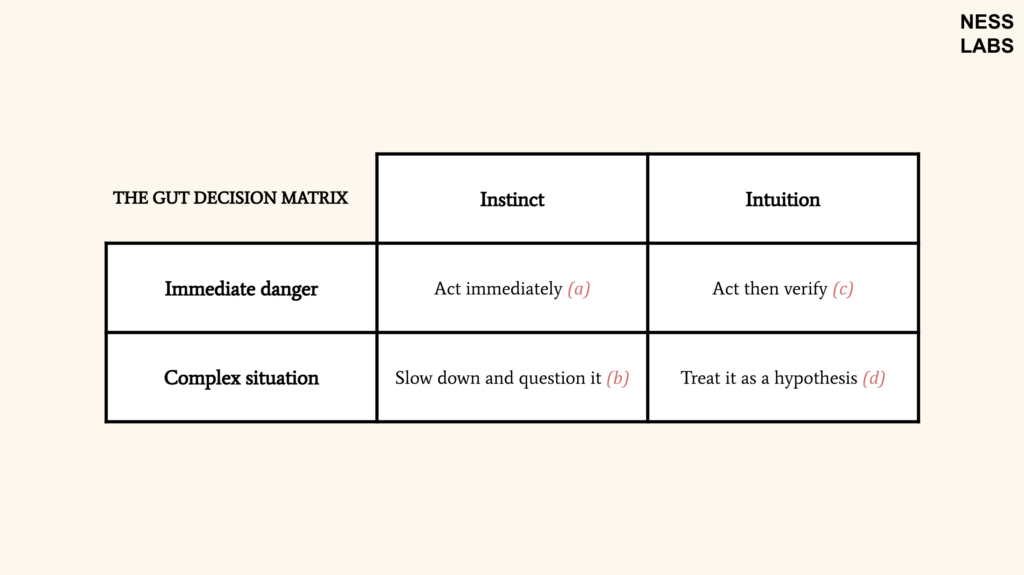
(a) If your response is instinct in immediate danger, it usually makes sense to act right away. These survival mechanisms evolved specifically to deal with situations where hesitation could be costly.
(b) However, instincts can misfire in modern contexts. When a situation is more complex, it’s often better to slow down and question the instinctive response before acting on it.
(c) If you have domain-specific expertise or experience in similar fast-moving situations, a strong intuition may be worth acting on quickly. In these moments you may not have time for deliberate analysis, so it can be reasonable to rely on your brain’s automatic pattern recognition, which can detect important signals faster than conscious reasoning.
(d) Finally, in slower-developing or more complex situations, it’s best to treat intuitions as hypotheses and examine them through additional thinking, evidence, or testing before committing to a decision.
Instinct and intuition both operate below conscious awareness, which is why they’re often lumped together as “gut feelings”, but they arise from different mechanisms and serve different purposes.
Instinct protects us from immediate threats. Intuition helps us recognize patterns we learned through experience. When we know how to distinguish between the two, our automatic responses become more useful.
So instead of asking whether to trust your gut, a better question is: what kind of gut feeling is this? Once you know that, deciding what to do next becomes much easier.